An illustrated analytical study of Andrew Webb-Mitchell’s Violin Concerto, Op. 5: its compositional history, formal architecture, harmony, thematic transformation and symphonic unity.
ANDREW WEBB-MITCHELL · OP. 5
An Illustrated Analytical Study
Contents
- The genesis of the concerto, 2013–2018
- Movement I — Three-Subject Sonata Form
- Movement II — Nocturnal Slow Movement
- Movement III — Finale
- The Concerto as a Whole
- Sources and Acknowledgements
The Genesis of the Concerto
Composition, orchestration and premiere, 2013–2018
Four years in the making
The Violin Concerto took shape over four years, from piano sketches made in Zhuhai in autumn 2013 to a fully orchestrated score completed by 28 November 2017. The composer recalls a long and difficult gestation. Its movements developed at different rates, its original two-part design gave way to three separate movements, and other work—notably Koh-i-Noor, Mountain of Light—interrupted its progress. Dated sketches, recordings and scores allow much of that process to be reconstructed.
Webb-Mitchell moved to Zhuhai, China, in 2013 to establish the Zhuhai Classical Children’s Choir. He completed the first movement’s piano sketch on 5 December. His recording Songs of Awe and Wonder was released that September, and selections from it were performed at the Beijing Modern Music Festival on 22 May 2014. The concerto thus began during a period of intense professional and creative activity.
Film music and the slow movement
In winter 2013–14, Webb-Mitchell was invited to submit music for the Chinese film Rebellious Teenagers (青涩日记). Given three excerpts, he prepared piano demonstrations shaped to follow the scenes’ emotional course. One surviving clip, Qing Se – Empathy, runs for about six minutes. The submission was rejected; the composer recalls that the filmmakers considered the music too mournful and repressive. None of it was used in the released soundtrack.
The composer recognised that the rejected material suited the expressive journey he envisaged for his concerto’s slow movement. A piano recording dated 16 February 2014 contains all its principal themes, and the film demonstration preserves substantially the same material. Another theme from the submission was used in Koh-i-Noor. The abandoned film music thus became a source for two orchestral works.
The released film, Rebellious Teenagers (2015), credits Webb-Mitchell for English translation, not for its soundtrack. That credit corroborates his involvement with the production without implying that his proposed music was accepted.
The first movement and Koh-i-Noor
The first movement’s themes preceded the Battle of Kobani in 2014–15. Extensive orchestration sketches are dated between 5 November and 22 December 2014, and the orchestral score was completed on 26 February 2015. The conflict subsequently informed the concerto’s historical associations, but it did not inspire thematic material already present in the 2013 manuscript.
Work on Koh-i-Noor, Mountain of Light, Op. 4, appears to have interrupted the concerto. Webb-Mitchell recalls being invited to provide music for the opening concerts at Zhuhai Opera House; the Russian National Orchestra performed Koh-i-Noor there under Thomas Sanderling at the turn of 2016–17. A contemporary announcement reports a recording of the piece in February 2016. Although the precise dates of its composition remain uncertain, the project helps explain the interval between the concerto’s early sketches and its completion.
The original two-part design
The concerto was first envisaged in two continuous parts, with the slow movement leading directly into the finale. A July 2016 orchestration sketch, headed II. Starlit Night in Kobane, preserves this design. Its first 63 measures contain slow-movement material; the music of the eventual finale begins at measure 64. Although the file reaches a written measure 434, it is not a completed 434-bar finale. Two extensive spans, measures 77–114 and 125–176, contain no pitched music in any instrumental part. Elsewhere, recognisable finale themes appear in positions and textures that were later revised.
A further piano sketch of the finale dates from 27 January 2017. By August–October that year, a 414-bar orchestral version had established most of the finished movement’s architecture, although its coda remained rudimentary and the quotation from Mahler’s Eighth Symphony was absent. Meanwhile, orchestration of the slow movement was underway by January 2017—nearly three years after its themes had been written for the film.
A demonstration recording dated 28 November 2017, described by the composer as fully orchestrated and containing both the finished formal structure and the Mahler quotation, provides the strongest evidence that the concerto was complete by that date. The quotation and developed coda were therefore in place by late November. After the Cologne premiere in April 2018, only minor details were revised; the structure remained unchanged.
From working titles to the premiere
The 2017 scores retain descriptive movement titles: Acts of Heroism, Kobani Starscape and No Friend But the Mountains. The concerto itself was earlier titled Arin Mirkan. These names document the work’s developing associations with Kurdish history; they were subsequently withdrawn from its published presentation. The dedication to Christopher Hitchens reflects a separate, long-standing philosophical affinity that gained added resonance through his advocacy of Kurdish rights.
The world premiere took place at the Gürzenich in Cologne on 29 April 2018, with Elisabeth Basoff-Darskaja as soloist and the Cologne New Philharmonic Orchestra conducted by Volker Hartung. Pervin Chakar was announced as a guest soprano in the wider programme. A report published by Artı Gerçek on 28 April named the Kurdish Community in Germany among the concert’s organisers. The earlier title Arin Mirkan remained prominent in the premiere publicity.
A film made in connection with the premiere records the responses of Hartung, Basoff-Darskaja and orchestra leader Arsenis Selalmazidis. The musicians praise the work’s melodies, idiomatic violin writing, musical logic and memorability. Hartung also explains the importance of Cologne’s Kurdish community to his choice of venue. Their comments offer first-hand testimony from the performers, distinct from independent criticism.
The premiere recording reached audiences beyond classical concert circles. YPJ International shared it in May 2018; an account named El Ángel de Kobane drew attention to it in March 2019; and Kurdish-associated accounts shared it again in 2025. A screenshot of the Mirovatî – Defend Rojava post from January 2025 shows approximately 38,000 post views. These figures document online circulation, not attendance at performances or critical appraisal.
Chronology of the surviving sources
Date | Document or stage of composition |
|---|---|
Autumn–5 December 2013 | First movement piano sketch; dated demonstrations of its principal sections. |
Winter 2013–14; 16 February 2014 | Film-scoring demonstrations for Rebellious Teenagers; themes later used in the slow movement. |
5 November–22 December 2014 | Extensive orchestration sketches for Movement I. |
26 February 2015 | First movement orchestral score completed. |
2015–16 | Work on Koh-i-Noor, which appears to have interrupted the concerto. |
July 2016 | Combined Part II score: slow movement joined to an unfinished finale. |
January 2017 | Second-movement orchestration underway; finale piano sketch dated 27 January. |
August–October 2017 | 414-bar finale, with most of its structure but without the Mahler quotation. |
28 November 2017 | Demonstration documenting the fully orchestrated finale and Mahler quotation; concerto complete by this date. |
29 April 2018 | World premiere in Cologne. |
2024 | Revised score with details refined; no post-premiere structural revisions. |
Movement I — Three-Subject Sonata Form
Exposition · development · recapitulation · coda
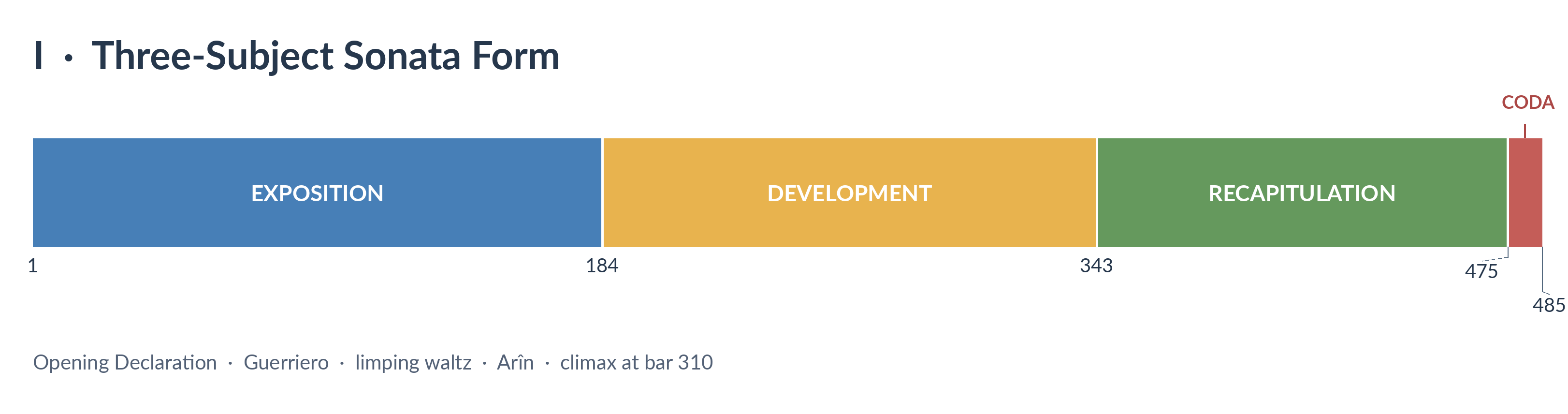
The movement in outline
The first movement (485 bars) is a three-subject sonata form whose contrasting groups comprise a martial opening, an irregular waltz and fanfare complex, and the expansive lyrical theme Arîn. Rising fourths, tritone-related harmony, chromatic transformation and sustained pedal points unify this varied material. A trumpet fanfare accompanying the soloist’s entrance grows into a dialogue between violin and orchestra. The development culminates at bar 310 in the movement’s densest counterpoint, before a transformed recapitulation and a final return of the opening motto.
Formal plan
Section | Bars | Thematic/structural function |
|---|---|---|
Exposition (overall) | 1–183 | Three-subject sonata form: Opening Declaration and three subject groups |
Opening Declaration | 1–6 | Fourth-based motto; conflict announced |
First Subject Group | 7–65 | 1A (7–26); bridge (27–34); 1B Guerriero (35–56); TF4 codetta (57–65) |
Bridge | 66–73 | Connecting passage |
Second Subject Group | 74–132 | 2A irregular waltz (74–89); 2B fanfare group (90–115); 2A return (116–132) |
Third Subject Group | From c. 134 to 183 | 3A introduction (flute/bassoon, from 134); Arîn (3B) enters at 151 |
Development | 184–342 | Motivic transformations; true climax at 310; development codetta from 326 |
Recapitulation | 343–474 | Transformed 1A; modal introduction; 3B return; second-subject ABA |
Final coda | 475–485 | Opening Declaration and F-major conclusion |
The exposition contains three subject groups. The third begins with an introductory flute-and-bassoon passage (3A), leading to the principal lyrical theme Arîn (3B) in the solo violin at bar 151.
Origins, dedication and historical associations
The first movement was drafted at the piano in Zhuhai in autumn 2013, with its sketch completed on 5 December. Orchestration continued through 2014 and was completed on 26 February 2015. Because the principal themes already appear in the 2013 manuscript, the associations later attached to the Battle of Kobani should not be confused with their origin.
The concerto is dedicated to Christopher Hitchens. His support for Kurdish rights later gave the dedication an added resonance, but the music is not a literal portrait. In the 2017 score, the first movement carried the title Acts of Heroism; the earlier title of the concerto was Arin Mirkan.
The composer associated Arîn, the third subject’s lyrical theme, with the women of the Kurdish YPJ (Women’s Protection Units). He also envisaged Kurdish or broader Middle Eastern colours in its introduction: flute, bassoon and tambourine in the exposition, and descending modal scales in the recapitulation. These passages are original compositions, not quotations of identified traditional melodies.
The 2013 piano sketch and the revised orchestral score
The 34-page piano sketch ends with the written bar number 497; the revised 2024 score ends at bar 485. Both place the development at bar 184, but the manuscript marks its recapitulation at 356 and its coda at 487, compared with 343 and 475 in the revised score. These figures provide a broad comparison, although changes to the musical text and one skipped manuscript bar number complicate direct correspondence.
Section | 2013 piano manuscript | 2024 revised score |
|---|---|---|
Exposition | 1–183 (183 bars) | 1–183 (183 bars) |
Development | 184–355 (172 bars) | 184–342 (159 bars) |
Recapitulation | 356–486 (131 bars) | 343–474 (132 bars) |
Final coda | 487–497 (11 bars) | 475–485 (11 bars) |
Complete movement | 497 numbered bars | 485 numbered bars |
The principal revision was a twelve-bar cut after sketch bar 189. Sketch bars 190–201, recalling exposition bars 13–20, were omitted, joining two passages rooted in G major and tightening the opening of the development. Two further bars, an additional 3/4–2/4 pair near the end of the developmental waltz, were removed before the Opening Declaration’s return. Its entry consequently falls at bar 290 in the revised score. The cuts eliminate fourteen bars of redundant material without changing the movement’s basic design.
Two separate 1/4 measures were added in the orchestral score, at bars 65 and 309; the latter produces the dramatic general pause before the climax at bar 310. The manuscript also skips the handwritten bar number 113. The resulting difference in numbered measures is therefore not equivalent to a simple count of deleted bars.
Piano demonstrations dated 30 November 2013 document the exposition and the development with recapitulation; a recording of the coda is dated 5 December. Together with the sketch, they show that the movement’s large-scale form was established before its orchestration. Later changes served chiefly to concentrate and sharpen it.
1. Opening Declaration — the conflict announced (bars 1–6)
The first six bars announce the movement’s dramatic conflict. Ascending perfect fourths form an Opening Declaration whose intervallic character recurs in later fanfares, although rhythm and orchestration give each appearance its particular identity.
A sustained bass anchors rapidly changing chromatic sonorities above it, with moments of displacement and release at bars 4 and 6. The upper voices and trombones move against this foundation, establishing a tension between harmonic stability and change that runs through the movement.
The chimes suggest a three-beat pulse against the notated 4/4. Conceived by the composer as an alarm, they sharpen the opening’s urgency. Beneath the tumult, recurrent rhythms, intervals and registers hold the texture together.
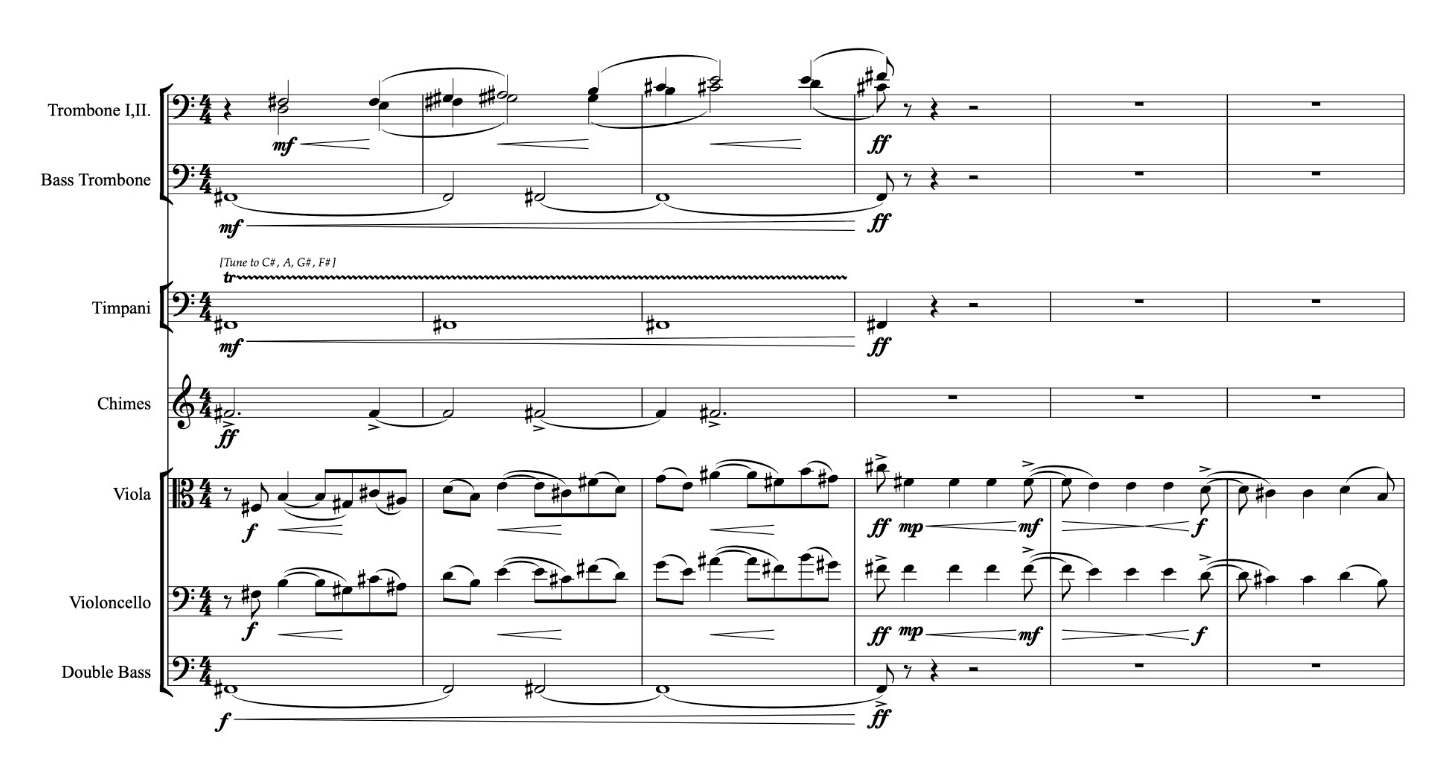
The Declaration returns at bar 290 before the principal climax, and at bar 475 to open the coda. Its final statement brings the movement back to its point of departure while directing the harmony towards a new conclusion.
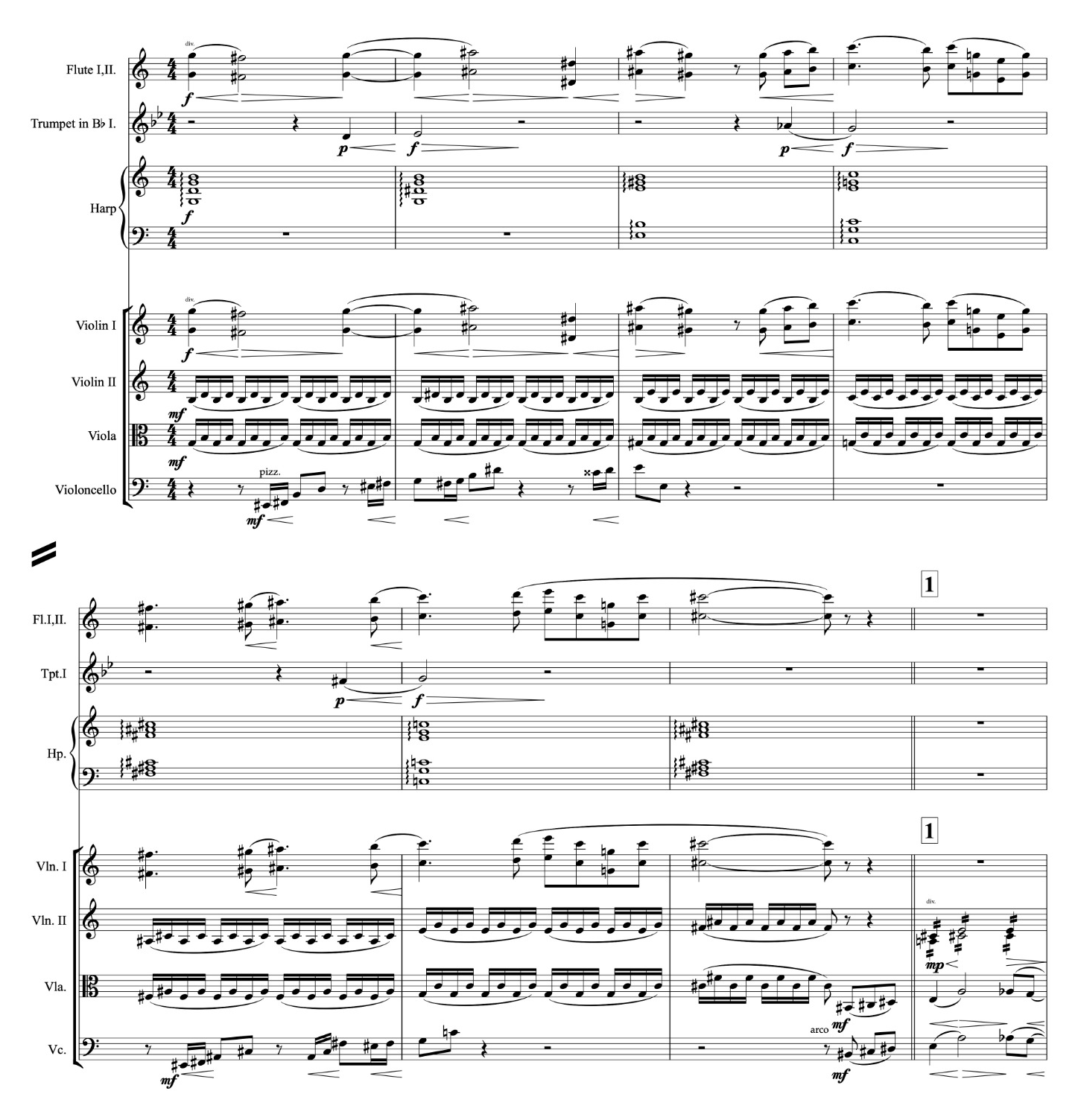
2. Theme 1A and the first-subject complex (bars 7–34)
Theme 1A (bars 7–26) is a closely integrated complex rather than a single unbroken melody. Semiquavers in second violins, violas and harp help define the opening harmony (bars 7–13). The principal line and second violins then lead the harmonic motion (bars 14–18), before exchanges between trumpet, woodwind and harp (bars 19–26) make orchestration part of the thematic argument.
Major-triad regions, chromatic voice-leading and tritone-related roots succeed one another without a conventional tonic–dominant progression. These relationships return at different pitch levels; in the recapitulation at bar 343, much of 1A is transposed upwards by a fourth and given a new opening sonority and orchestration.
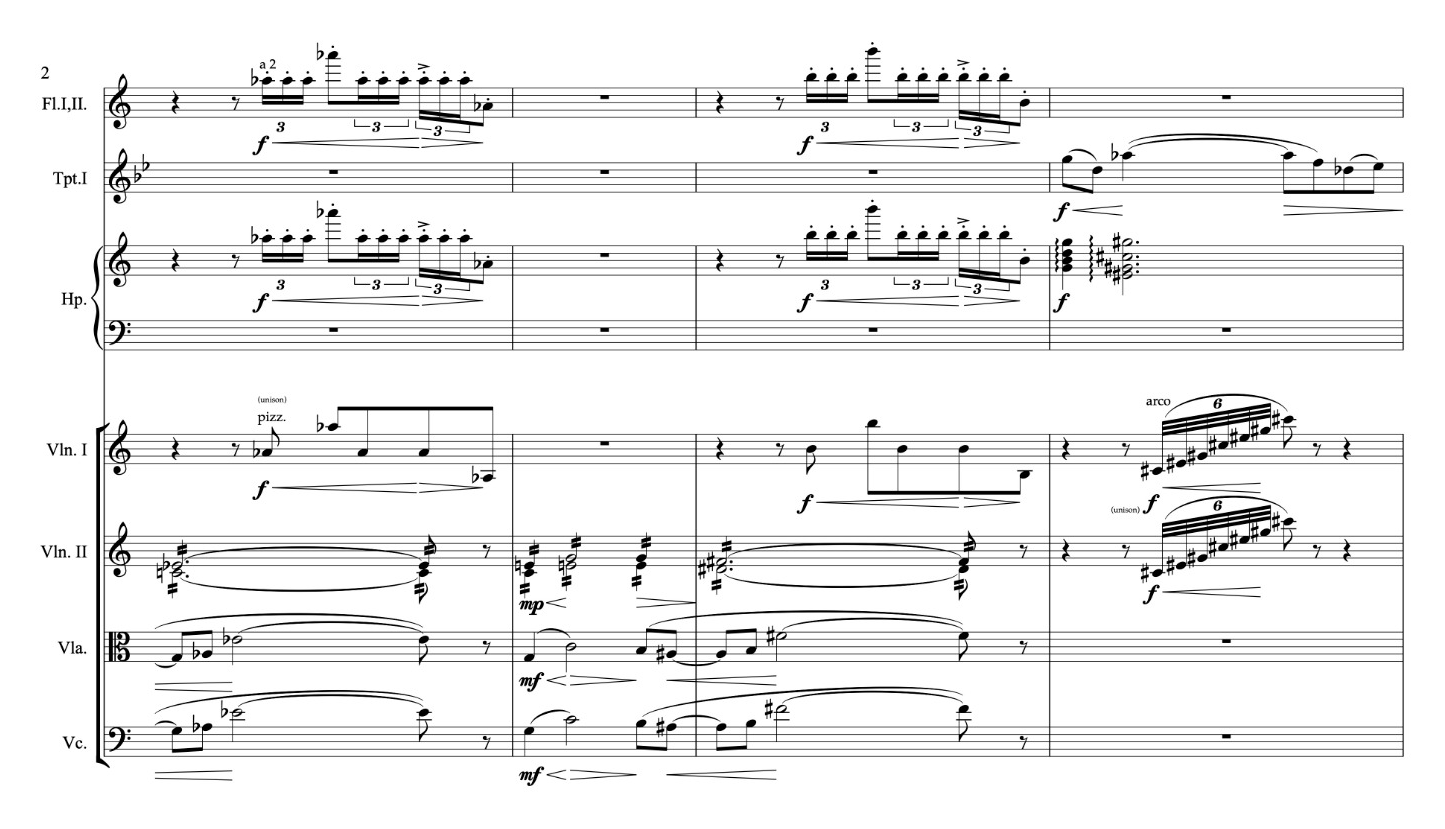
A short bridge, beginning with the upbeat to bar 27, connects 1A to Guerriero. Its rapid alternations of major and minor colour increase momentum towards the trumpet theme without developing into an independent recurring subject.
3. Guerriero and the Tritone Fanfare (bars 35–65)
Guerriero (1B) begins with the upbeat to bar 35, announced by Trumpet I. Repeated string attacks, accented harp writing and an active bass give the theme its martial momentum. It draws on the opening’s harmonic and intervallic language but retains a distinct melodic identity.
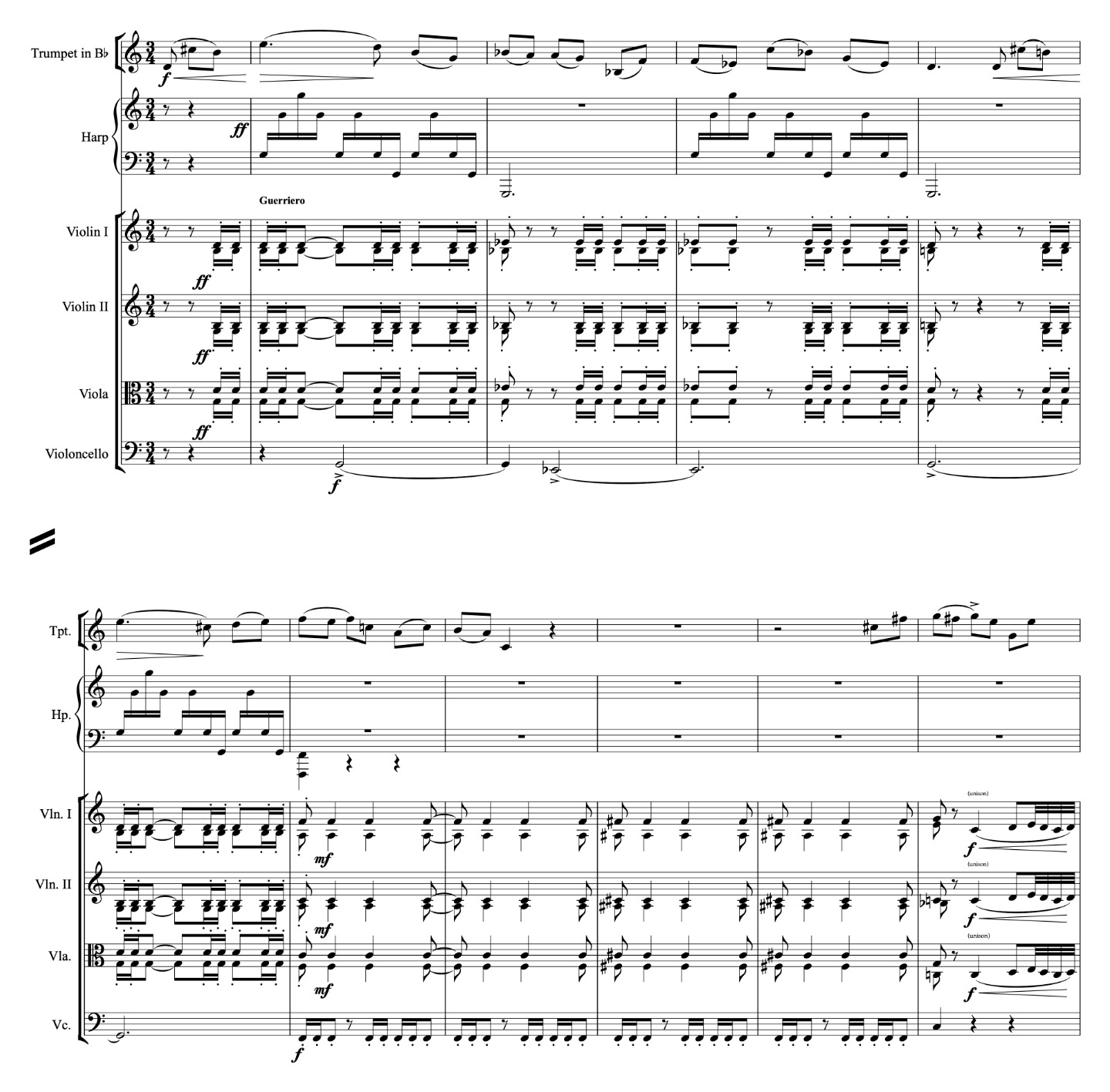
The codetta introduces the Four-note Tritone Fanfare (TF4) with the upbeat to bar 57. Its written trumpet pitches are D–G–D–G♯: a perfect fourth up, a perfect fourth down and an augmented fourth up. Beneath the call, F-major and B7 harmonies lie a tritone apart, yet share notes that help connect the changing sonorities.
The trumpet sounds the call as the solo violin enters for the first time. The soloist answers with emphatic repeated notes and octaves. This call-and-response pattern becomes a defining relationship between violin and orchestra.
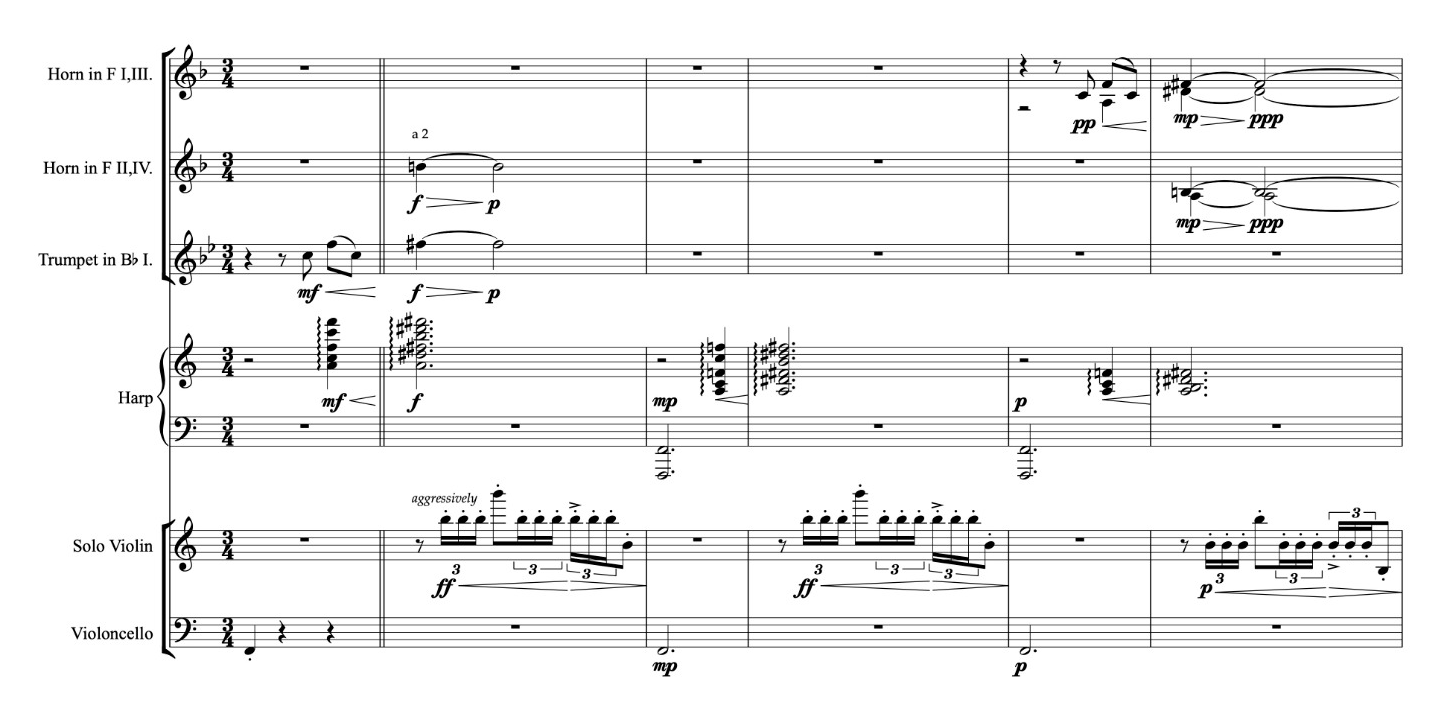
The fanfare and octave response return in Theme 2B and in the development codetta. Their identity rests on the exchange as a whole, not solely on an exact repetition of the four-note trumpet figure.
4. Second subject group — irregular waltz and fanfares (bars 74–132)
The bridge at bars 66–73 leads to the second subject group, organised 2A–2B–2A. Theme 2A is an irregular, or “limping”, waltz: three bars of 3/4 followed by one of 2/4. The pattern remains recognisable when its melody changes later.
Major–minor alternations, augmented-triad colours and abrupt shifts of harmony unsettle the dance. Harp and lower strings clarify the changing foundations beneath its recurring metre.
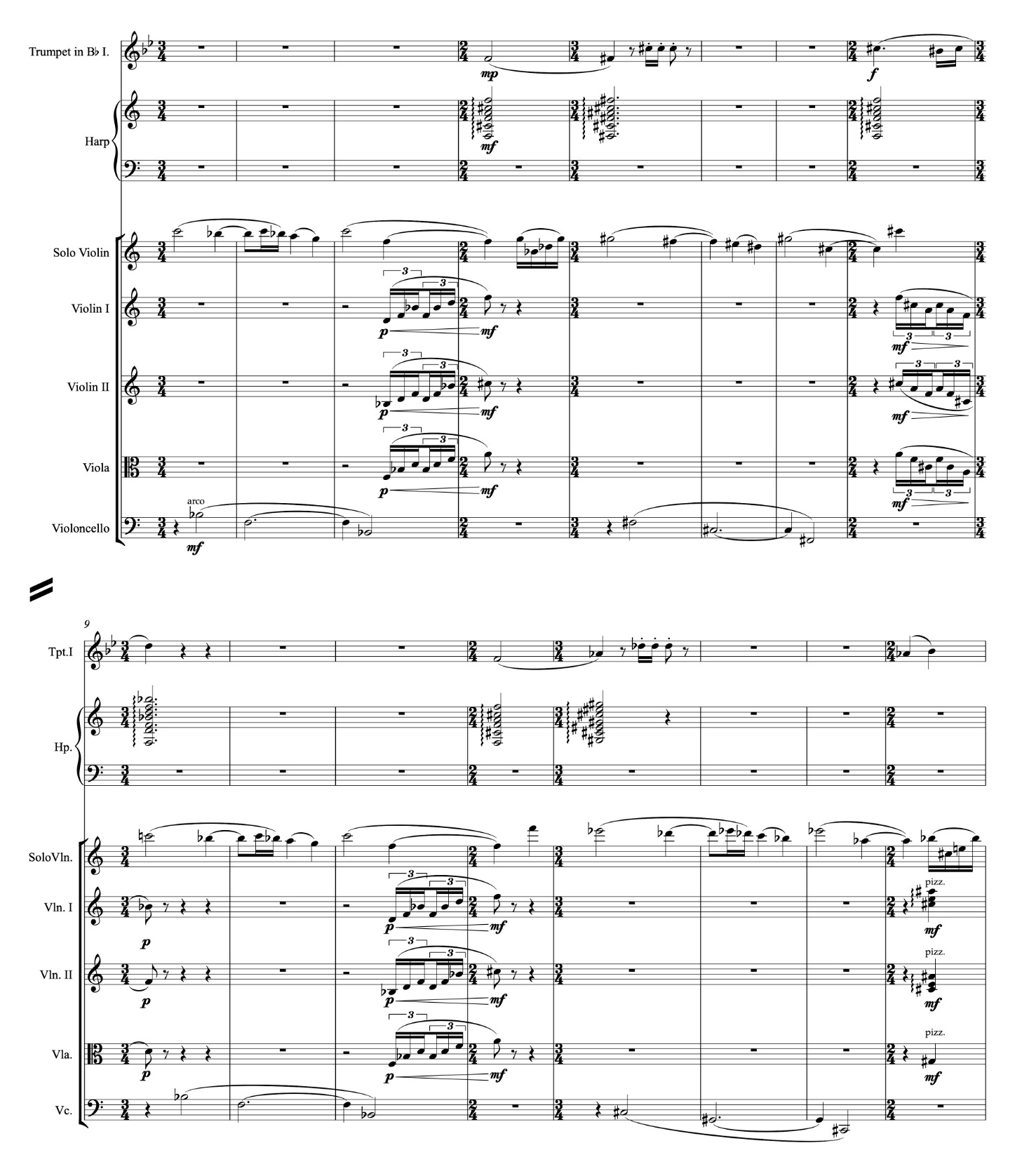
Theme 2B begins with an upbeat during bar 90 and expands TF4 into the Eight-note Tritone Fanfare (TF8). The first four principal notes preserve TF4’s intervallic profile in transposition; the remaining four extend it, sometimes with an ornamental turn. A horn statement of TF4 answers the solo violin’s expanded call, followed by characteristic violin octaves. The resulting twelve-note complex belongs to a dialogue, not to a single uninterrupted melodic line.
Form | First key occurrence | Defining features |
|---|---|---|
TF4 — Four-note | Anacrusis to b. 57 | P4 up, P4 down, A4 up; initial trumpet call with solo violin entrance |
TF8 — Eight-note | Anacrusis to b. 91 | Expanded principal notes, sometimes with ornamental turn |
12-note complex | Bars 90–97 (then repeated) | TF8 in solo violin, TF4 horn answer, characteristic solo-violin octave response |
Perfect-fifth variant | Anacrusis to b. 207 | Same initial fourth gestures, but the final A4 is replaced by P5 |
Structural TF4 return | From b. 326 | Recollection of original fanfare and soloist’s octave figuration |
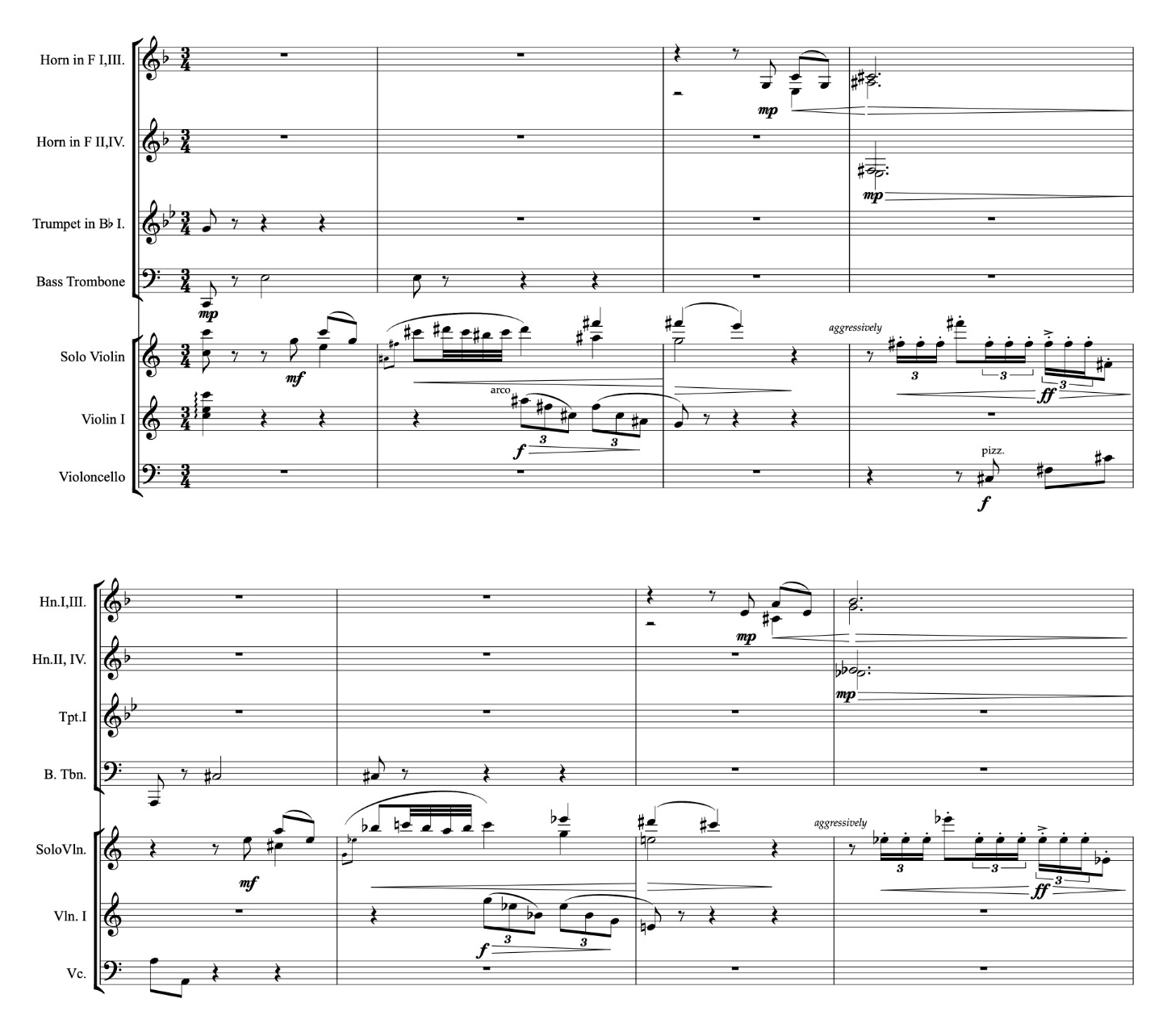
The dialogue recurs within 2B and in the recapitulation. Chromatic semiquavers from around bar 98 supply a further motive, later heard beneath the modal introduction to Arîn.
The waltz returns at bar 116, completing the 2A–2B–2A plan: irregular dance, fanfare dialogue, and dance reprise.
5. Third subject group — introduction and Arîn (bars 134–183)
The third group brings the exposition’s broadest lyrical contrast. A flute melody at bar 134, repeated by bassoon at bar 142, forms its introduction (3A); recurring tambourine and sustained harmony establish a relatively static, modal atmosphere. At bar 151, the solo violin introduces Arîn (3B), the principal lyrical theme.
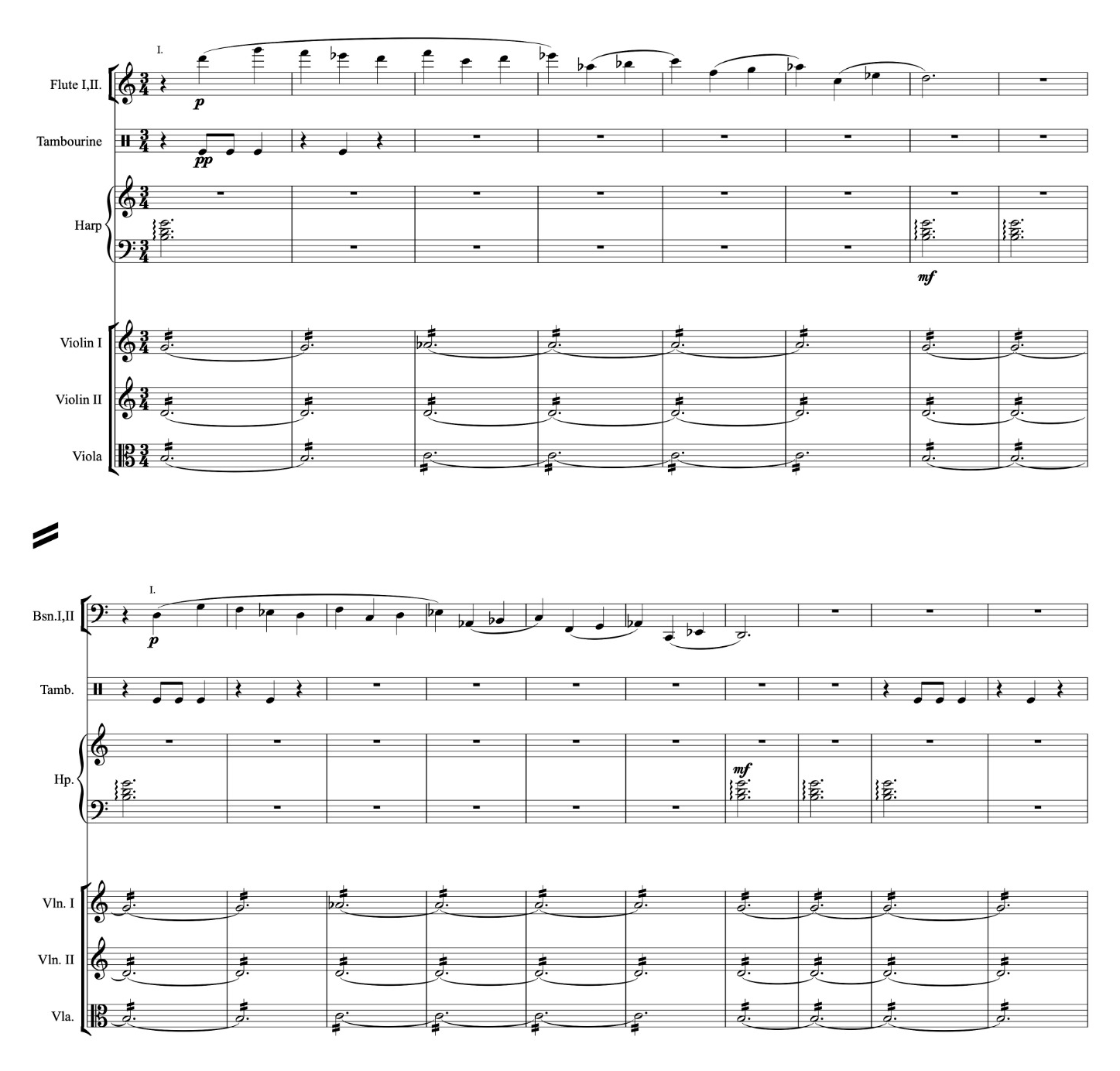
Arîn unfolds more freely than Guerriero or the irregular waltz. Its late arrival, after two sharply contrasted subject groups, gives the exposition a spacious new character. The composer later connected the melody with the women of the Kurdish YPJ, bringing associations of courage and dignity to its musical expression.
Sustained strings and broad harmonic spans support the violin; harp figuration becomes prominent from bar 152. D♭-major and C-minor-related harmonies distinguish the theme’s first presentation, while the transparent accompaniment leaves its melodic line unobstructed.
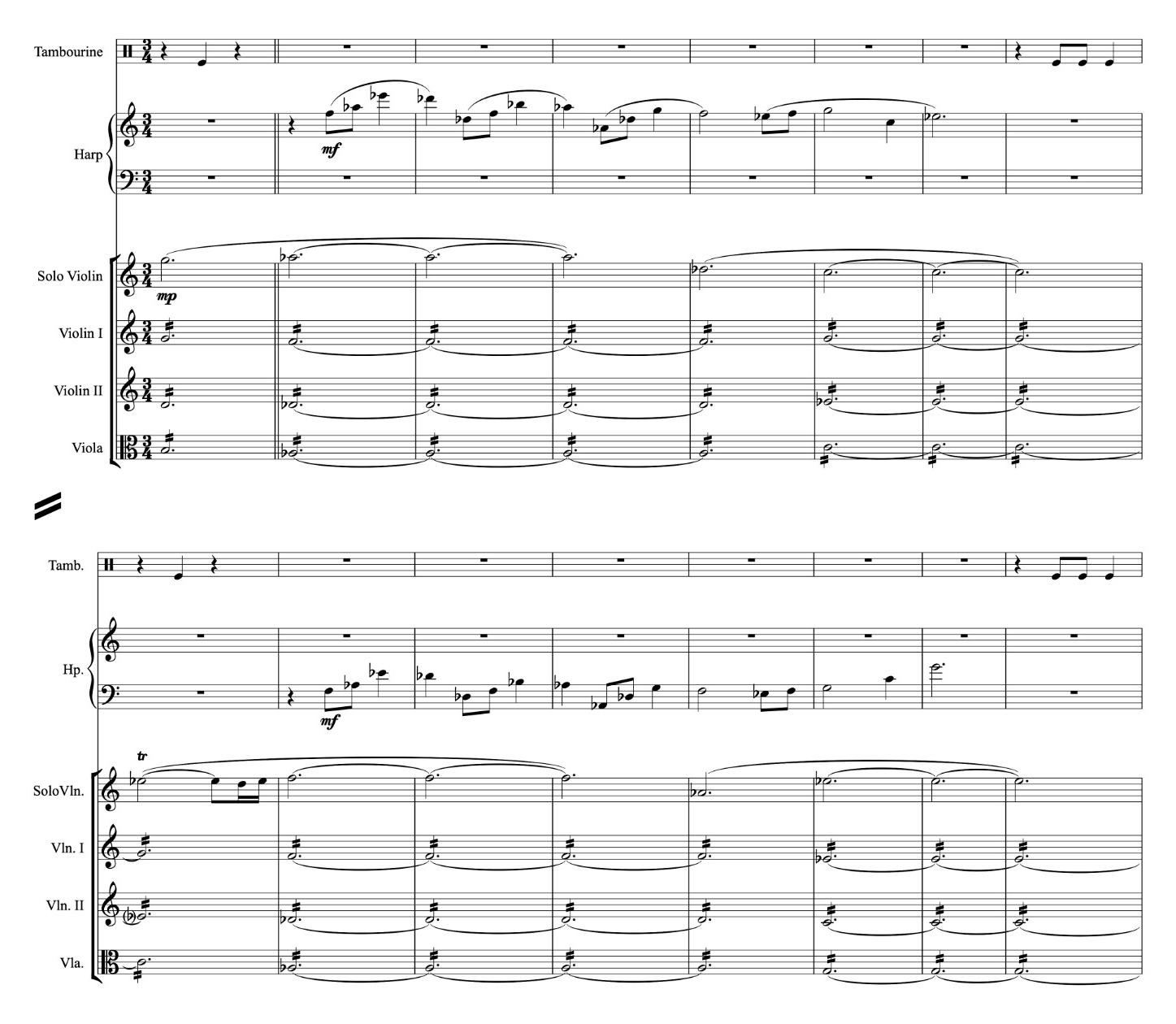
Both the modal introduction and Arîn appear in the 2013 piano sketch. The theme’s Kurdish association therefore belongs to a later stage of interpretation. The violin’s rising line at the exposition’s close leads directly to the development at bar 184.
6. Development I — thematic transformation (bars 184–289)
The development opens at bar 184 with 1A. The chromatic figure from 2B follows around bar 190, and 3A returns at bar 194. Themes previously heard in succession now interact in fresh tonal and orchestral settings.
With the upbeat to bar 207, TF4 is transformed into C♯–F♯–C♯–G♯. Its initial movement by fourths remains, but the final augmented fourth becomes a perfect fifth. Rhythm and contour preserve the fanfare’s identity while its intervallic and harmonic profile changes.
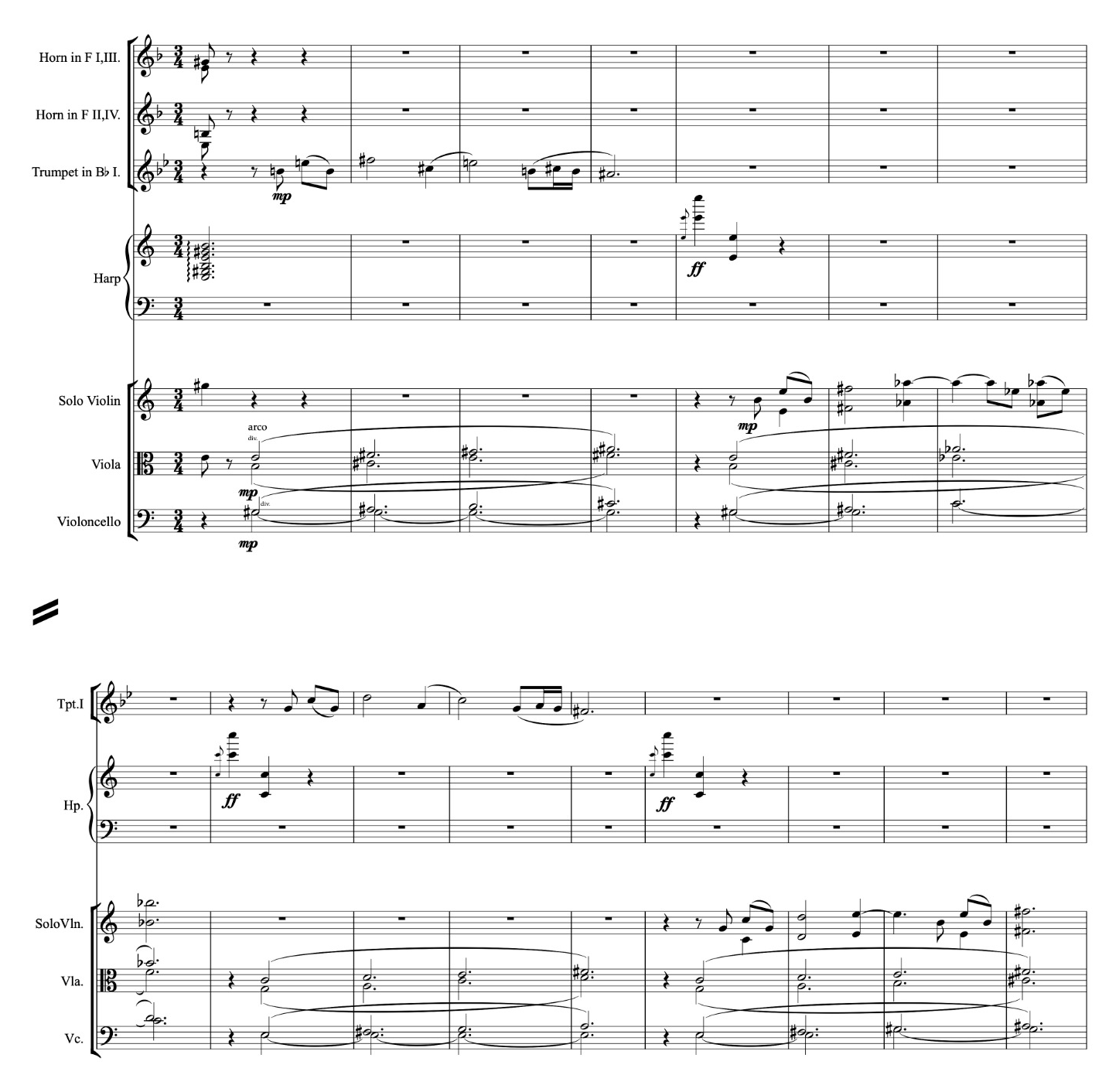
After a brief episode at bar 222, 3A returns at bars 238–241 and from bar 246; the chromatic 2B figure intervenes at bars 242–245. Much of the harmonic framework at bars 246–258 lies a fourth above the earlier 3A passage at bars 194–206. The fanfare’s perfect-fifth variant also returns, with the upbeat to bar 259, at a new pitch level. Related transformations sustain the development across these extended passages.
At bar 274 the waltz reappears with its 3/4–3/4–3/4–2/4 pattern but a new ascending melodic contour. G, E♭, A and F major-triad regions mark a changing harmonic direction beneath the familiar rhythm.
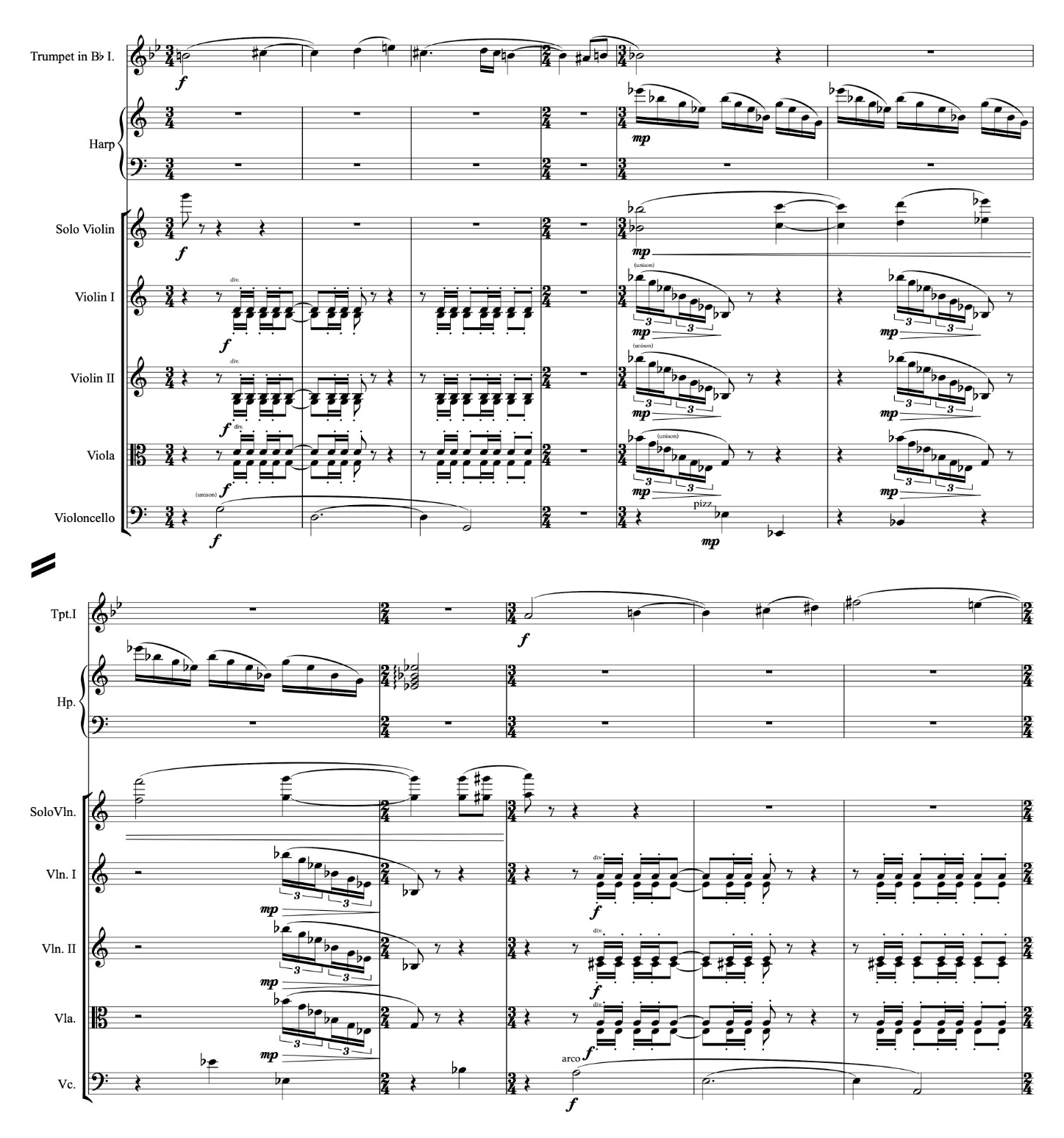
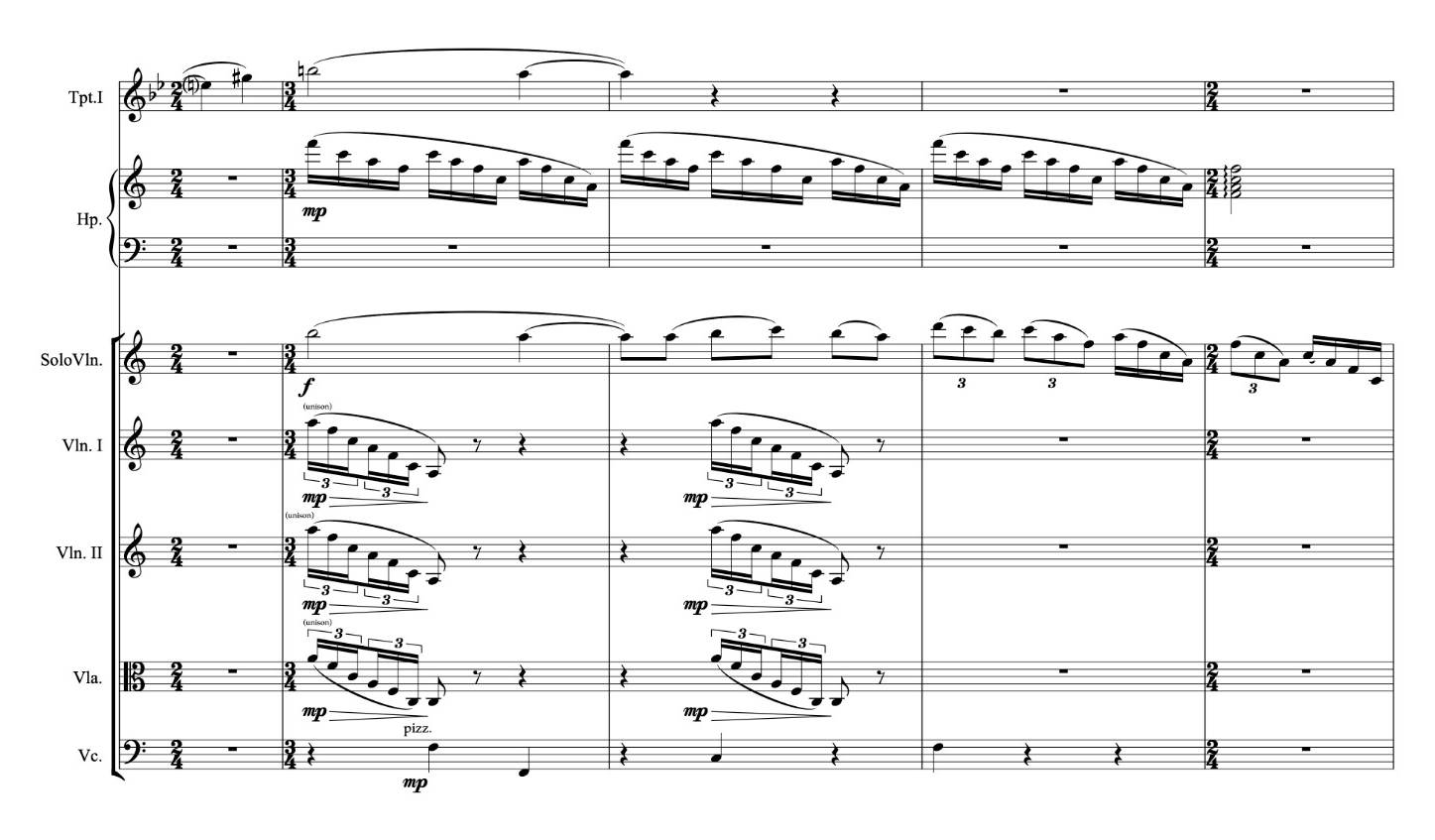
The Opening Declaration returns at bar 290, preparing the principal climax. The recapitulation itself will not begin until bar 343.
7. Development II — preparation and climax (bars 290–325)
The Declaration reappears at bar 290. At bar 293 the solo violin introduces a broad new climactic melody, answered by Trumpet I: violin at bars 293–296 and 301–304, trumpet at 297–300 and 305–308. The violin’s second statement lies a fourth higher, moving the harmonic focus from E7 towards A7. The composer conceives this as a distinct climactic idea, not simply another form of TF4.
At the same time, clarinets and bassoons introduce a descending-and-returning semiquaver figure (bars 293–294), imitated by flutes and oboes (295–296). The pattern returns at a new pitch level. Upper-string arpeggios reinforce the harmonic motion and prepare the more independent contrapuntal writing to come.
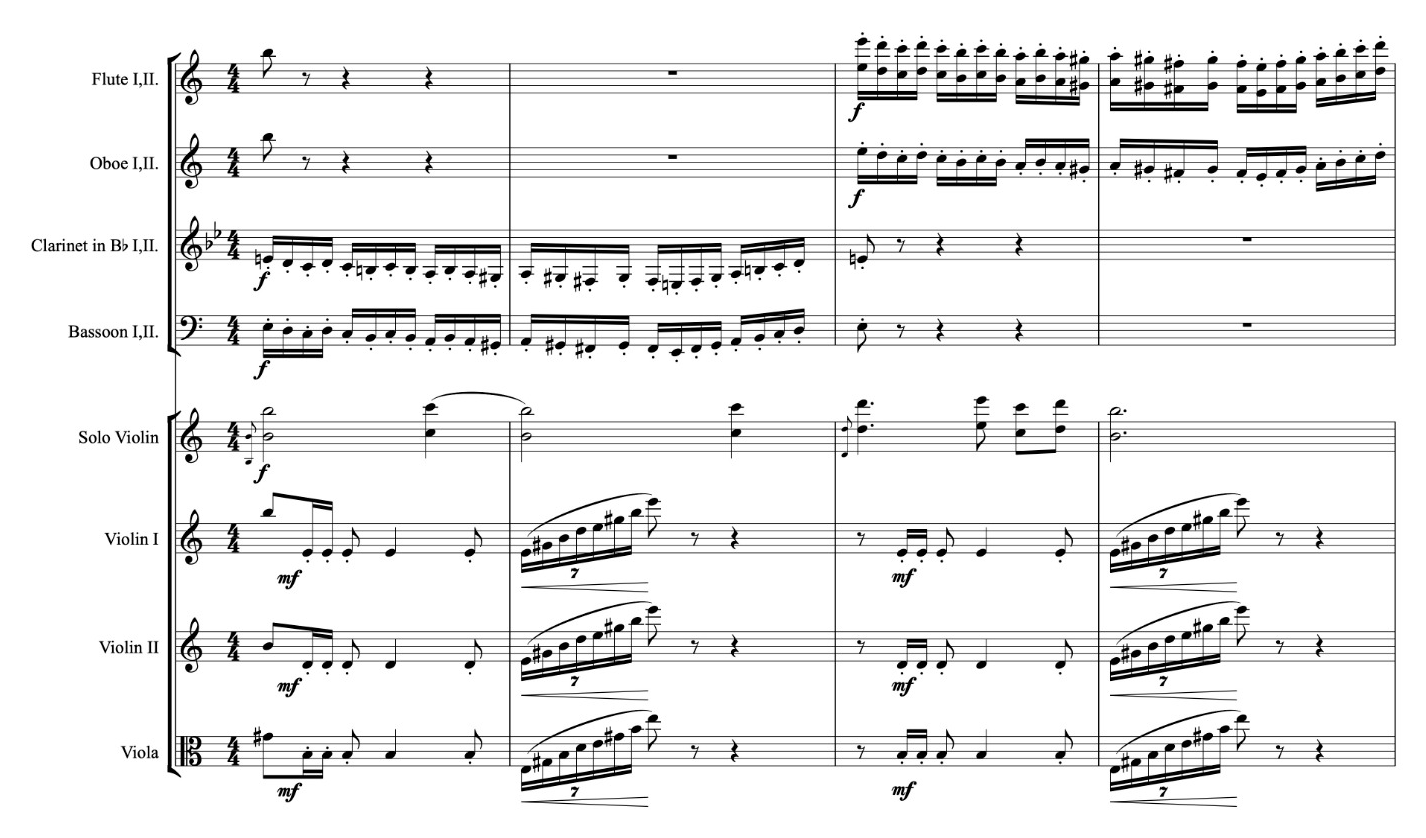
A one-quarter general pause at bar 309 interrupts the accumulation of energy. The solo violin then begins its third and fullest statement at bar 310, the movement’s principal dramatic climax.
Five orchestral layers converge: imitative woodwinds, a staggered three-part upper-string canon, syncopated lower strings, trumpet fanfares in octaves and the solo violin’s soaring melody. Violas, second violins and first violins enter in sequence, approximately two crotchets apart, before the canon continues more freely. Each layer maintains its rhythmic identity within the climactic texture.
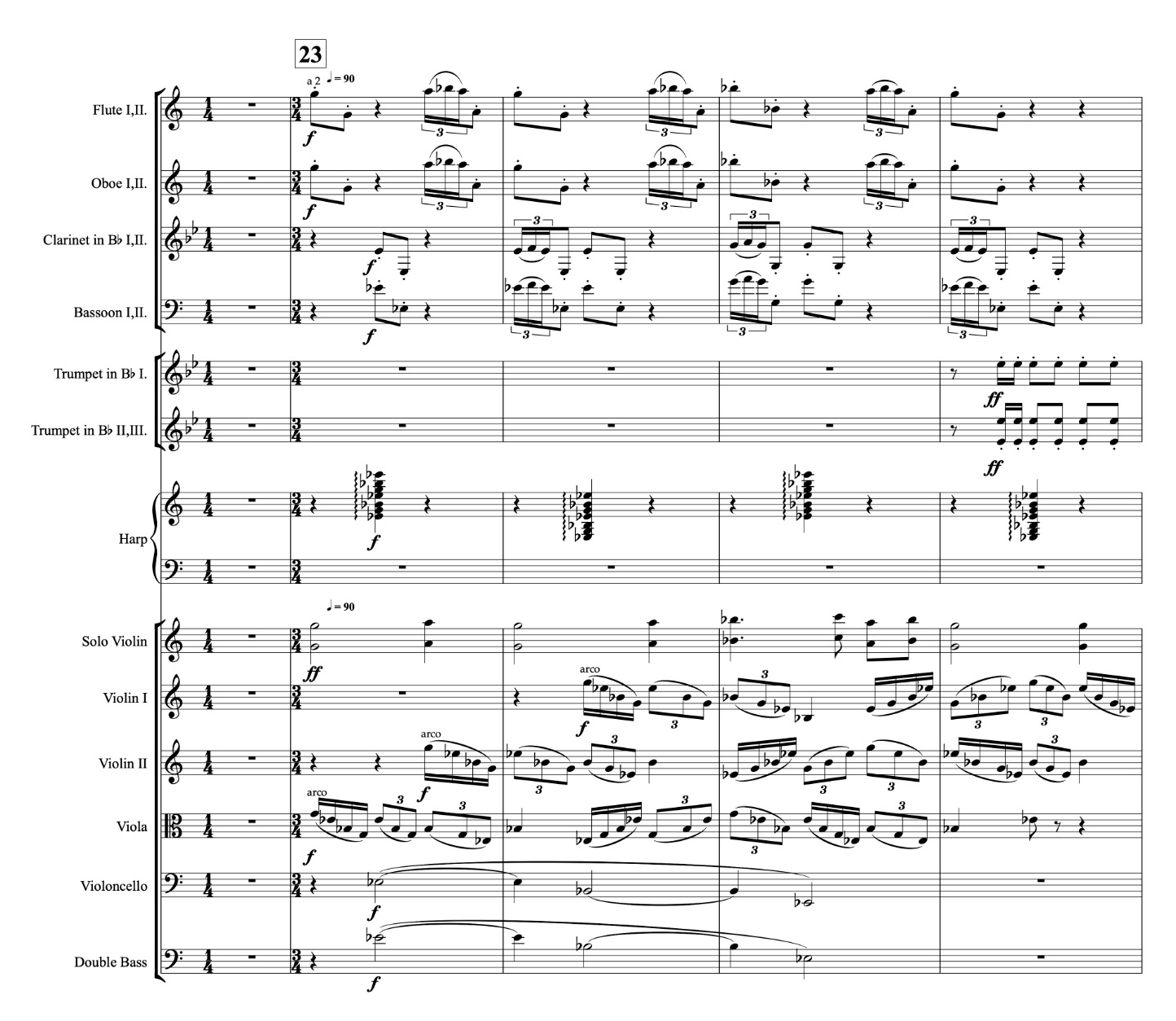
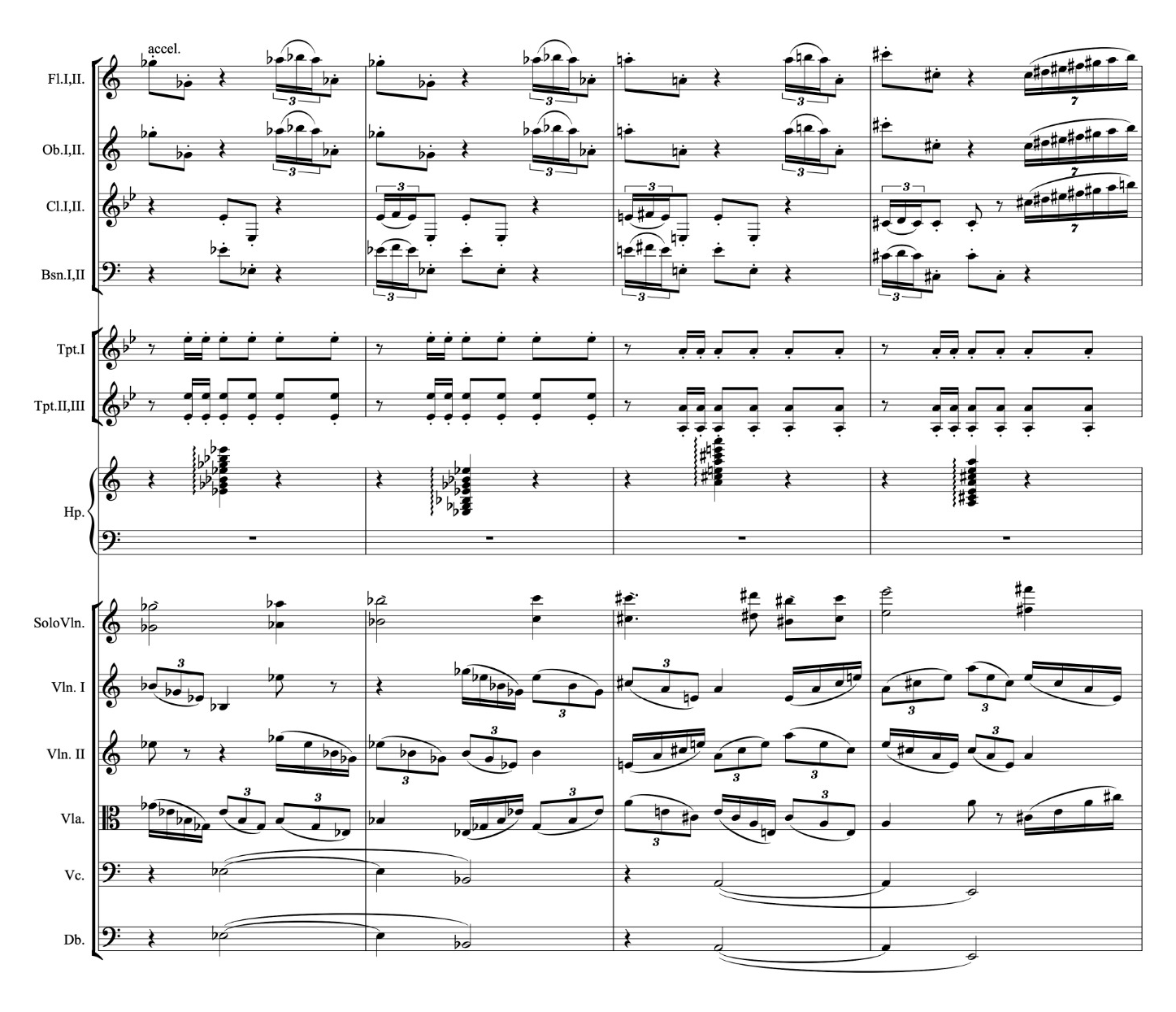
The climax moves through E♭-major, E♭-minor and A-major colours. Major–minor alteration and tritone-related shifts recall earlier harmonic procedures. From bar 318, material related to Guerriero, especially bar 44, helps carry the music into the development codetta.
The composer placed the climax near the movement’s Golden Section. Bar 310 falls about 64 per cent of the way through 485 written measures, compared with the mathematical proportion of approximately 61.8 per cent. Different metres and tempi mean that its position in performance time would be different; the more significant point is the deliberate concentration of contrapuntal forces at this juncture.
8. Development codetta — the fanfare returns (bars 326–342)
At bar 326 the Four-note Tritone Fanfare returns with the violin’s answering octave figuration, recalling the soloist’s first entrance. Horns increasingly take over the call, reinforcing the dialogue between orchestral signal and solo response.
The original F-major/B7 alternation returns. Repeated horn calls at bars 334–339 build intensity before the soloist answers with an ascending scale. Sustained B7 colour under that ascent prepares the recapitulation at bar 343.
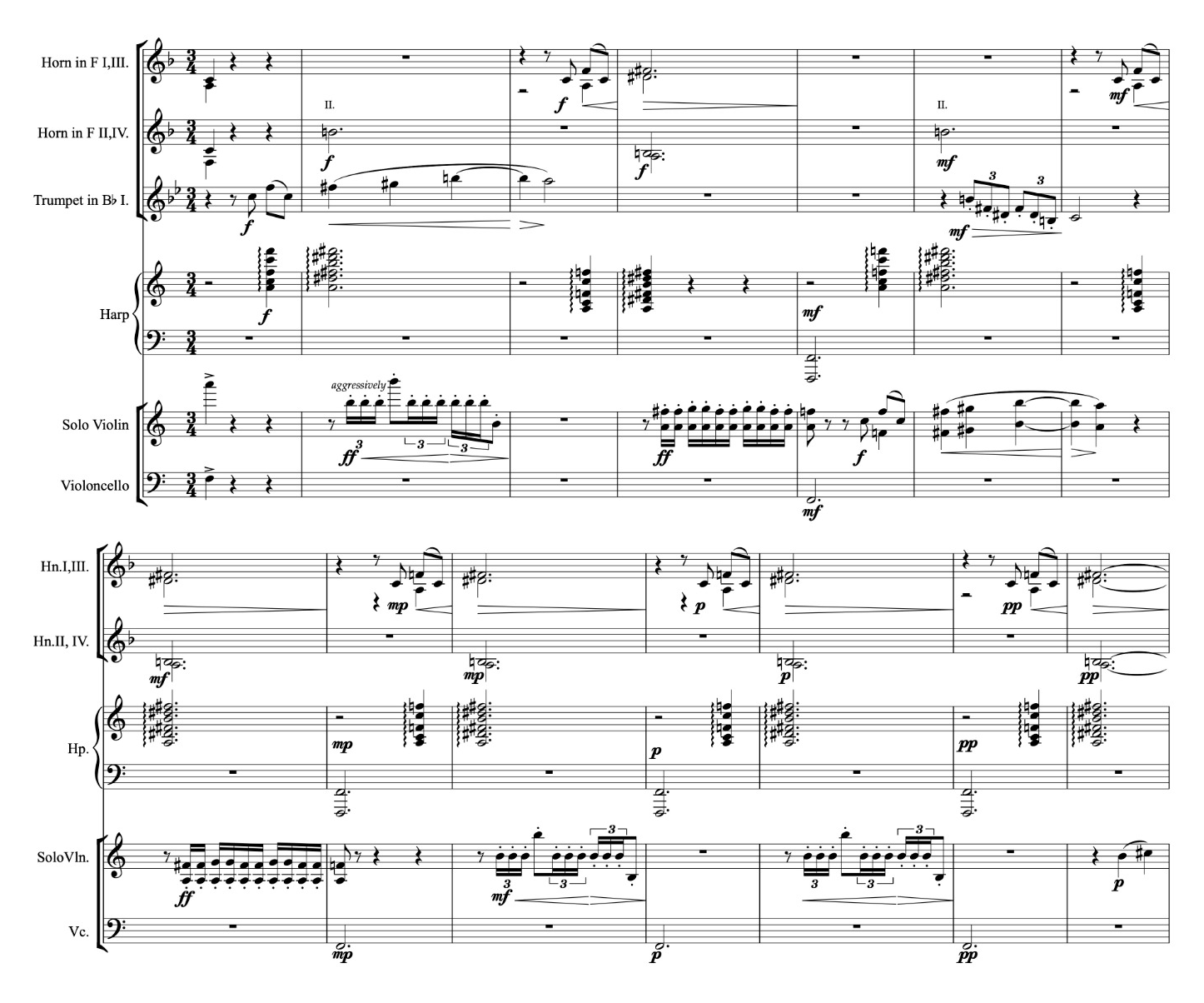
By now the fanfare has announced the soloist, expanded into a thematic dialogue, generated a transformed developmental variant and marked the end of the development. Its several roles help unify the movement.
9. Recapitulation — familiar themes transformed (bars 343–474)
Theme 1A returns at bar 343, largely a fourth higher but with altered register, orchestration and opening harmony. The soloist takes up material previously assigned to inner or lower voices, revealing a familiar theme from a changed perspective.
The preparation for Arîn is more thoroughly recomposed. From bar 358, descending modal scales replace the exposition’s static flute-and-bassoon introduction. E♭-centred Phrygian-dominant or Hijaz-related inflections move above a sustained E♭ bass, alongside chromatic figures derived from 2B. The orchestral transformation preserves the introduction’s expressive role while changing its musical substance.
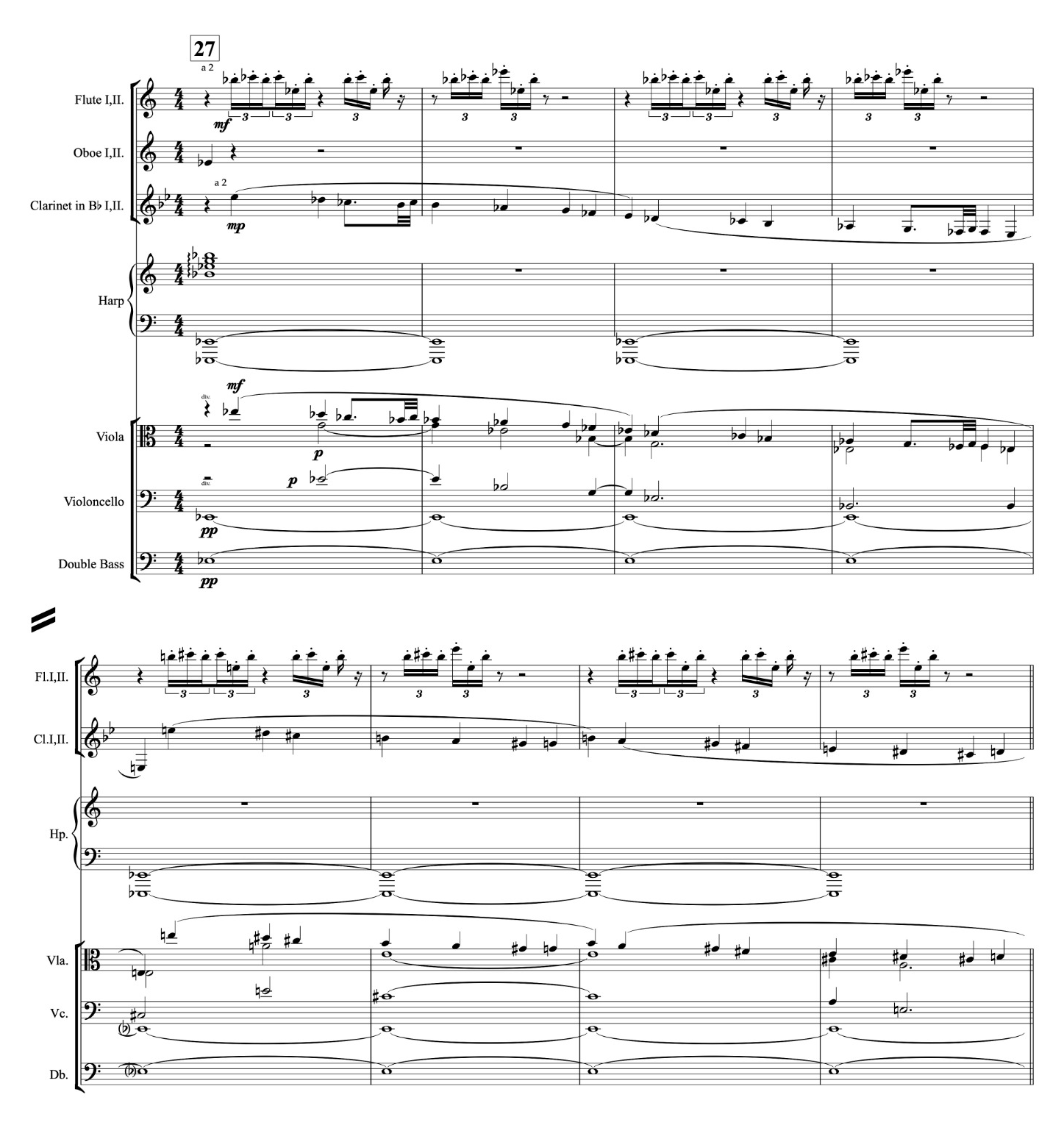
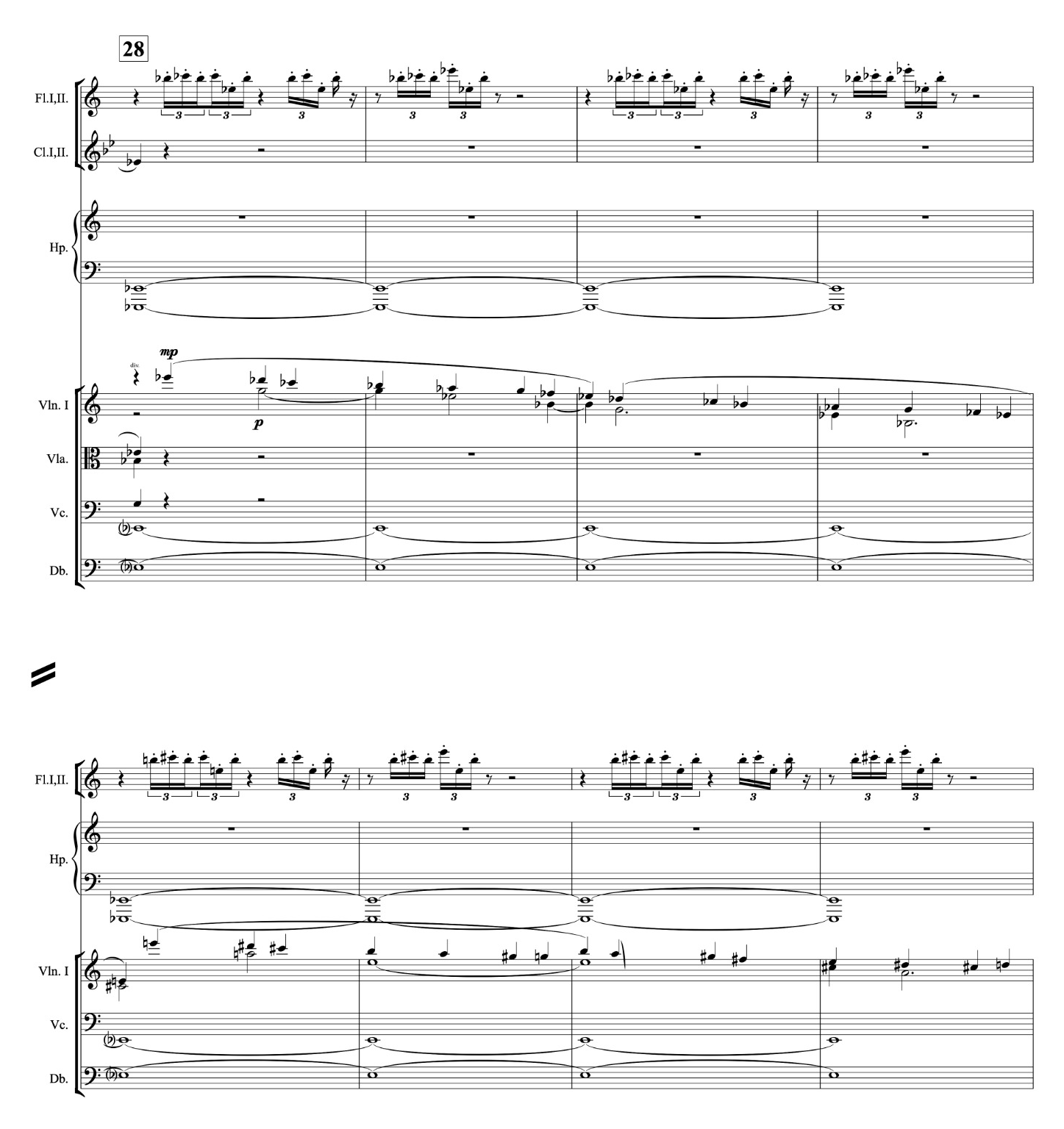
Arîn returns in the solo violin at bar 374. Its melody remains recognisable, but a new accompaniment and transposition create a more chromatically active setting. An A♭ pedal supports shifting upper harmonies in place of the broad D♭-major and C-minor-related regions of the exposition.
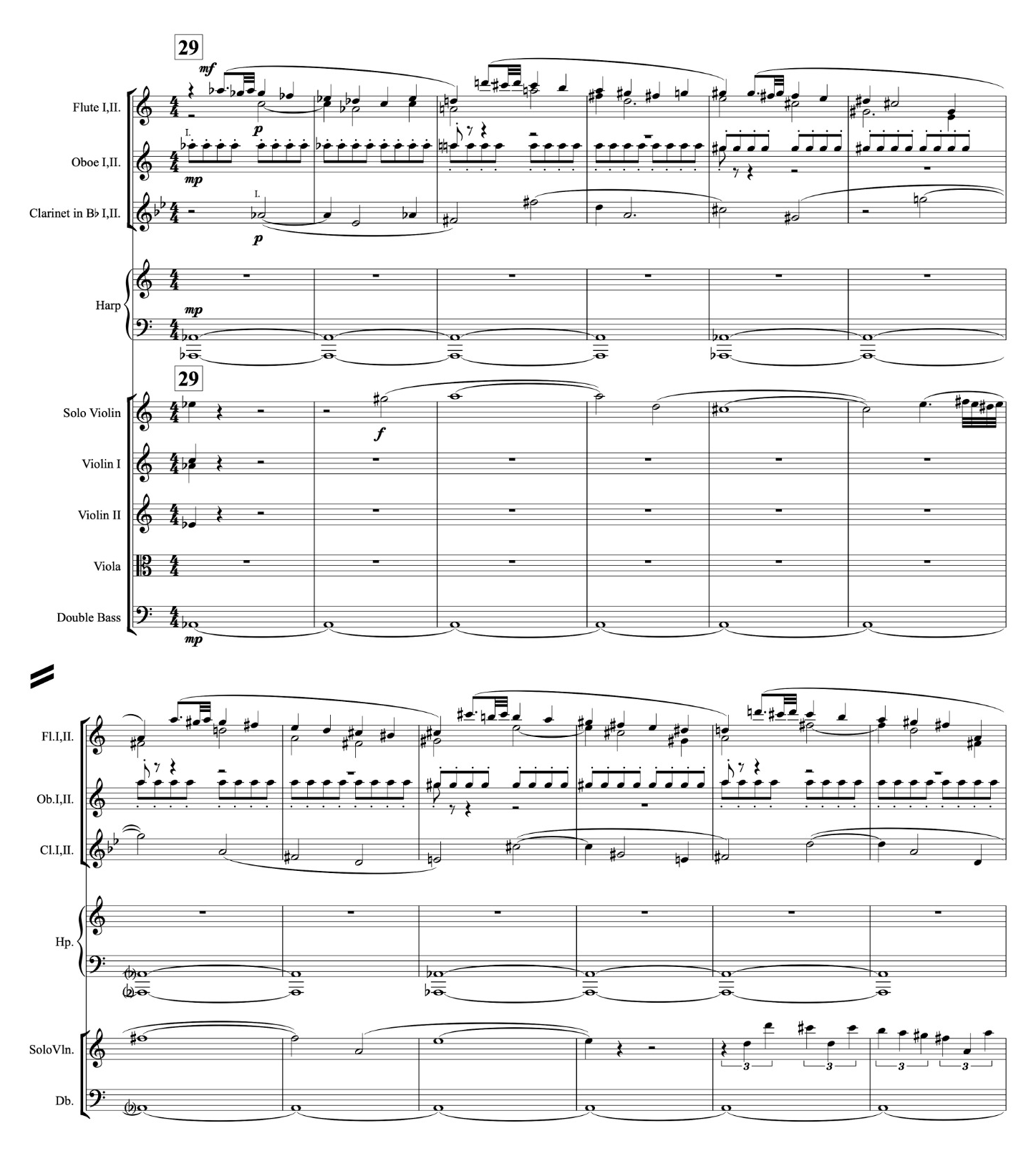
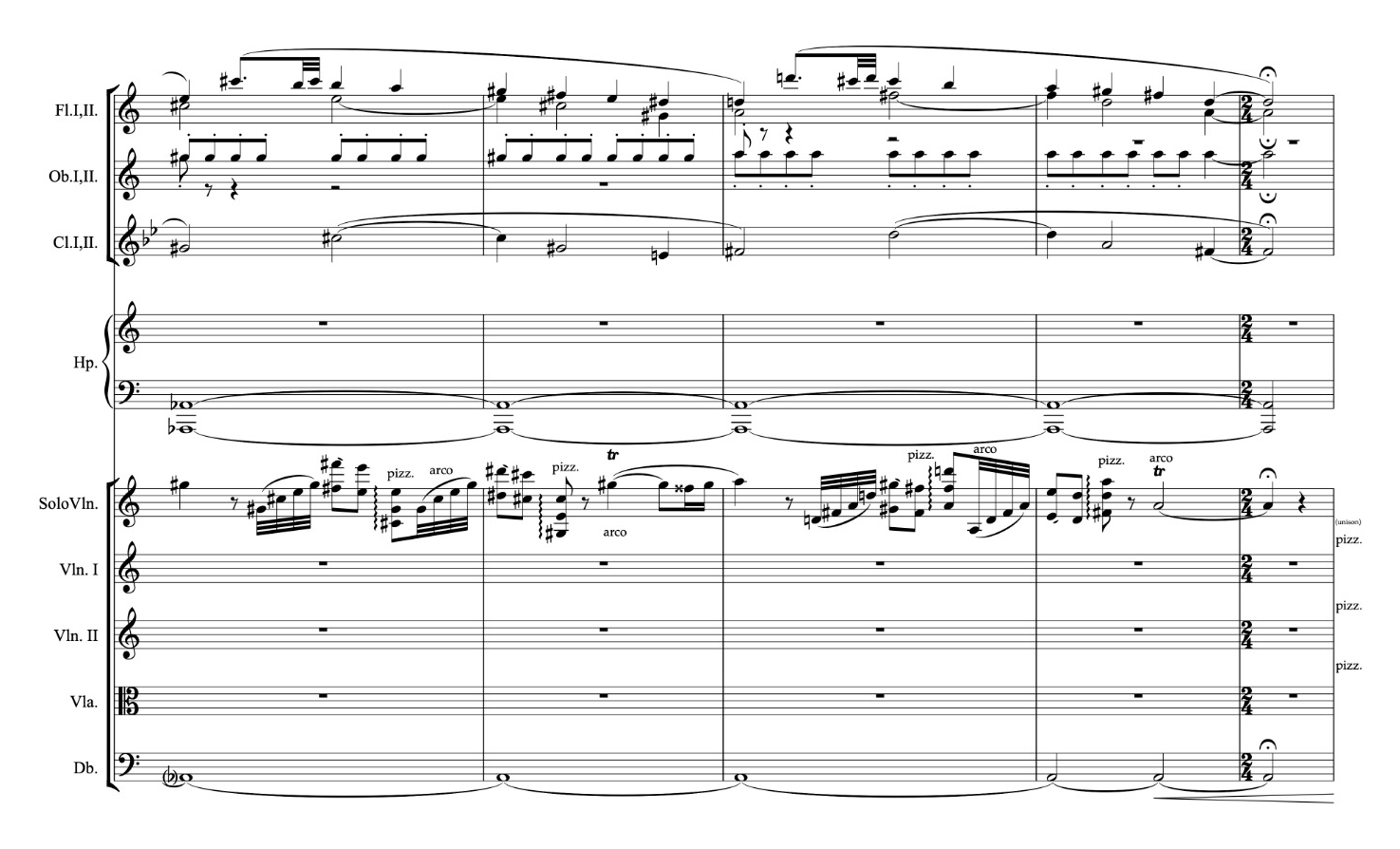
From bar 391, first-subject material and chromatic procedures return. A gesture near the upbeat to bar 403 recalls the fanfare without repeating its complete profile; around bar 407, A♭-major and D7 sonorities renew the movement’s contrast between major triads and tritone-related dominant-seventh harmony.
The second subject group returns in its original 2A–2B–2A sequence: irregular waltz around bar 414, fanfare group from the upbeat to bar 431, and waltz reprise at bar 457. New keys and orchestration do not obscure its rhythmic identity or the fanfare–soloist dialogue.
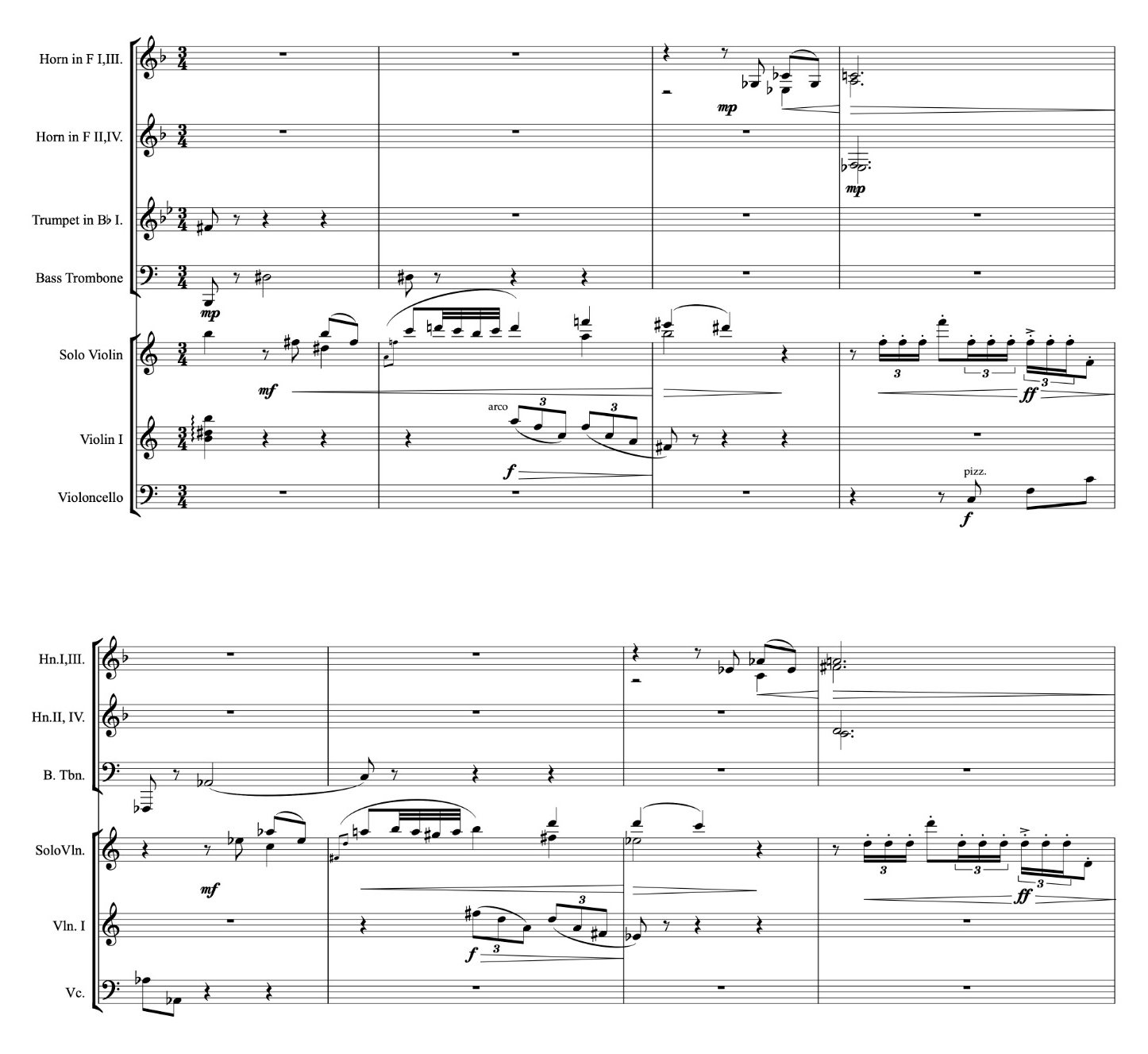
In the closing recapitulation, a C-major region yields to an extended G♭-major sonority, then descends by semitone to F. This prepares the coda’s F-major destination while recalling the movement’s characteristic harmonic contrasts.
10. Final coda — return and conclusion (bars 475–485)
The Opening Declaration returns at bar 475 for the last time, now moving decisively towards F major. Its fourth-based motto brings the movement’s dramatic argument full circle while revealing a new harmonic destination.
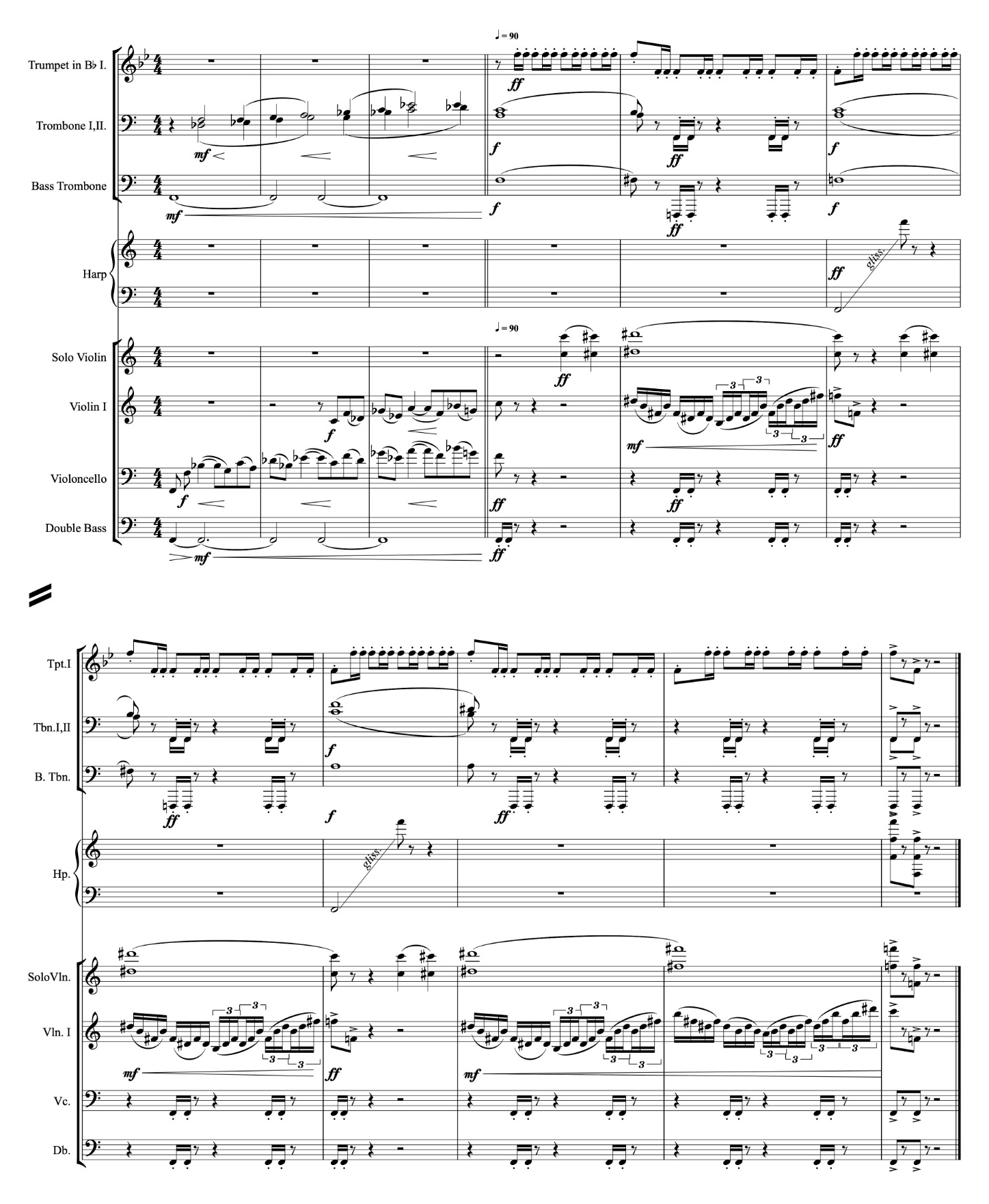
The coda concentrates the opening motto, shifting upper harmonies and sustained bass into a forceful close. The decisive effect is recognition of earlier material in a changed context, rather than the introduction of a further theme.
Conclusion — three subjects, one musical argument
A compact family of recurring ideas—rising fourths, fanfare calls, octave responses, irregular metres, pedals and tritone-related harmony—binds the movement’s sharply contrasted subjects. Their identities remain audible through transposition, orchestral exchange and recomposition.
The fanfare undergoes the clearest motivic transformation: a four-note call grows into an instrumental dialogue, changes its final interval during the development, and returns at a structural turning point. Arîn supplies a complementary process: the melody remains intact while its introductory setting is completely recast.
The climax at bar 310 brings the argument to its contrapuntal height; the Declaration’s final return resolves it in F major. Musical structure and the work’s later historical associations thus illuminate one another without being interchangeable.
Principal sources for Movement I
The principal sources are the autumn 2013 piano manuscript and demonstrations dated 30 November and 5 December 2013, together with the revised 2024 orchestral score. Their comparison documents the two developmental cuts. The thematic names Guerriero, Tritone Fanfare and Arîn, the intended modal colour and the climactic function of bar 310 are confirmed by the composer.
Movement II — Nocturnal Slow Movement
Thematic exchange, orchestral climax and a contemplative close
The movement in outline
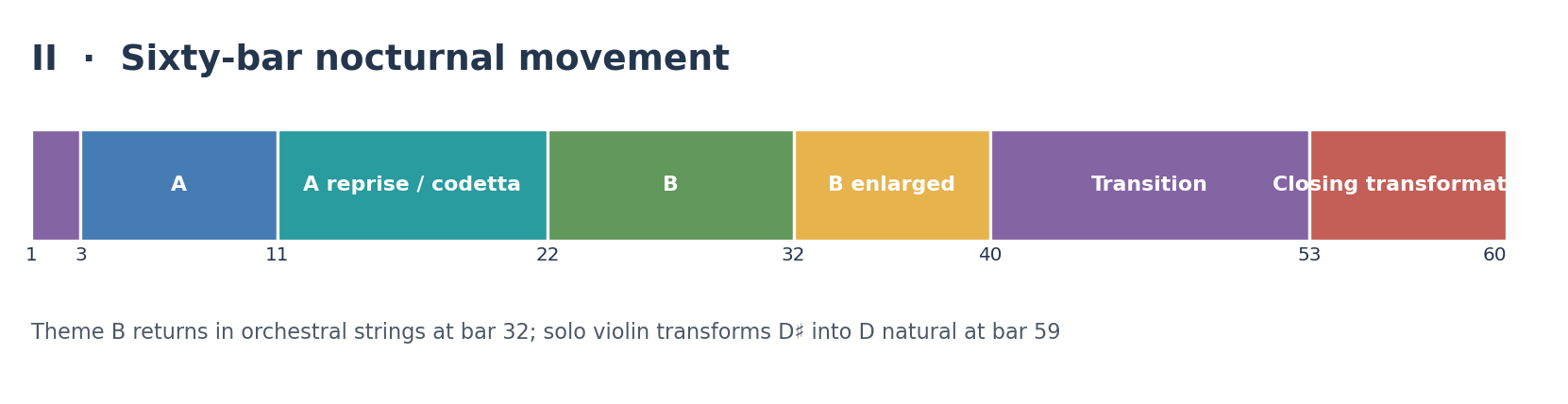
The 60-bar slow movement consists of two principal themes, each stated twice, followed by a coda leading into the finale. Theme A begins in the orchestra, with the solo violin gradually acquiring an independent voice. Theme B is introduced by the soloist at bar 22, then enlarged into an orchestral climax at bar 32. A recurring bassoon figure links its two statements, while harp and glockenspiel colour the closing passage. The last solo phrase changes a single pitch—from D♯ to D natural—transforming its expressive character.
Formal plan
Bars | Formal function | Principal features |
|---|---|---|
1–2 | Brief orchestral introduction | Implied E7, subdued colours |
3–10 | Theme A: first statement | Eight-bar orchestral melody, harmonic appoggiaturas, solo violin first heard in bar 10 |
11–18 | Theme A: second statement | Orchestra repeats the theme beneath independent solo-violin material; solo violin takes the closing melody in bar 18 |
18–21 | Theme A codetta | Descending appoggiatura figure transferred to the soloist and exchanged with lower strings |
22–29 | Theme B: first statement | New lyrical seven-note head motive, extended solo-violin melody |
30–31 | Bassoon closing figure | Original motif concluding Theme B |
32–39 | Theme B: orchestral restatement | Intended emotional climax; Violin I and viola carry the melody; soloist completes it in bars 38–39 |
40–60 | Coda and transition | Bassoon motif returns; changing metre and harmony; pensive final chromatic alteration; attacca connection |
1. From film demonstration to nocturne
The slow movement grew from piano music submitted for Rebellious Teenagers in winter 2013–14 and subsequently retained for the concerto. Its original dramatic character, rejected by the filmmakers as too mournful and repressive, proved suited to the movement’s emotional course. The later title Kobani Starscape added a nocturnal association. In the orchestral score, harp and glockenspiel suggest points of light, while muted trumpets, sustained strings and descending horn phrases create a quiet, reflective atmosphere.
The form depends on two themes and an exchange of roles. Theme A belongs first to the orchestra, from which the soloist gradually emerges; Theme B moves in the opposite direction, from solo violin to an expansive orchestral statement. The contrast provides the movement’s expressive shape without a conventional ternary return.
2. Introduction and Theme A (bars 1–10)
An implied E7 harmony opens the movement, pointing towards A minor. An orchestral violin phrase in bar 2 receives an answer from the horn. Theme A begins at bar 3 without a straightforward consonant arrival: B in Violin I moves towards A, while G♯ in the viola rises to the same pitch. These opposing resolutions establish the appoggiatura language of the theme.
At bar 4 the viola assumes the melodic initiative. Its repeated E becomes a dissonance against F-minor harmony in bar 5 and resolves to F, while Violin II adds a separate G–F appoggiatura. The move from A minor to F minor retains the common pitch C and shifts other chord tones by semitone. Repetition thus creates tension through changing harmonic context.
The process continues in bars 6–7, where a repeated G♯ in Violin II takes on a new harmonic function before resolving. The harp outlines D–F♯–A at bar 7; Violin I returns to the foreground in bar 8. At bar 9, viola and cello introduce a descending figure that will become important to the soloist.
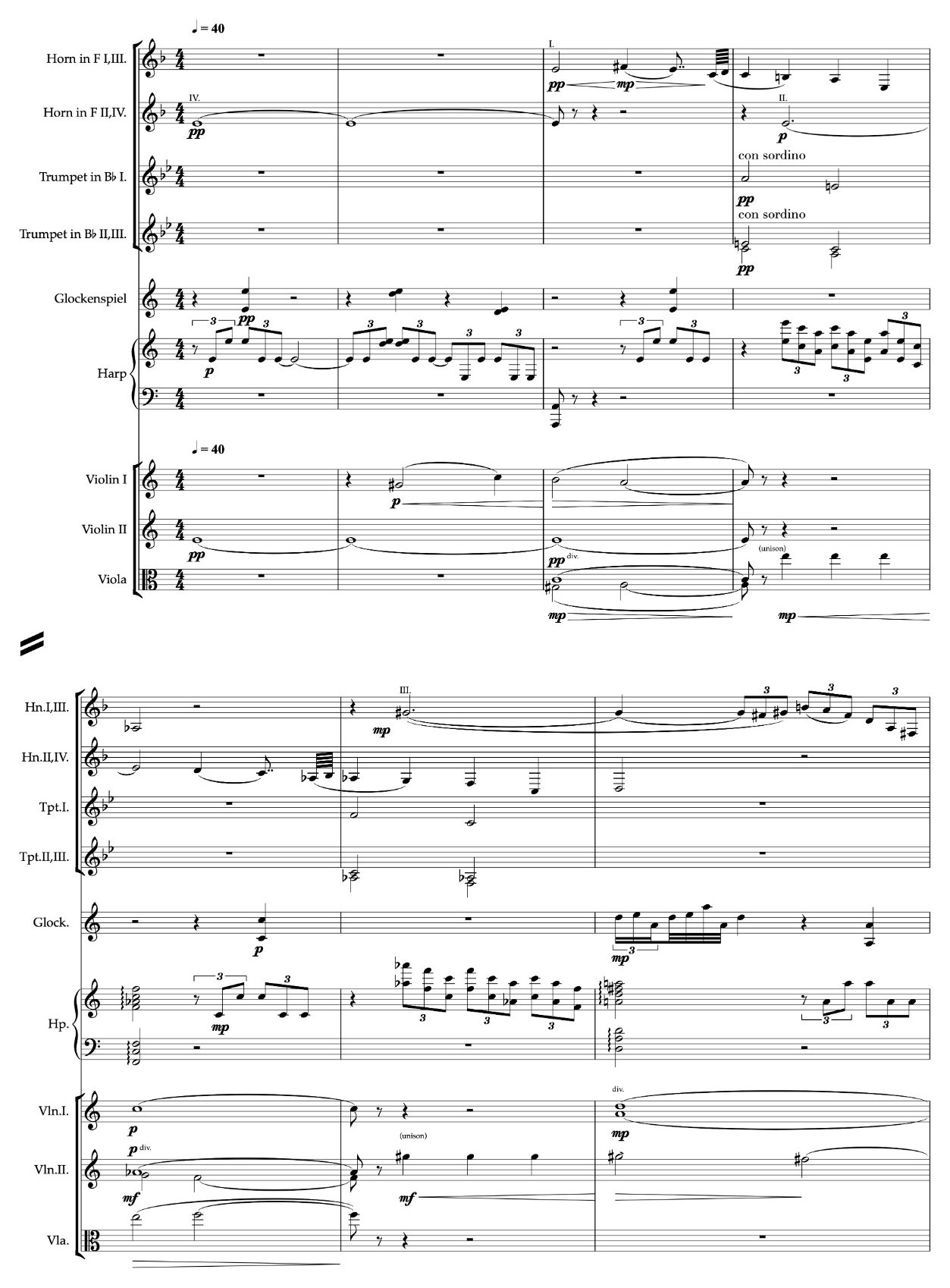
3. Theme A repeated: the soloist emerges (bars 11–21)
Theme A occupies bars 3–10, with the solo violin entering only in its final bar. When it returns at bars 11–18, the orchestra preserves the theme while the soloist develops a separate line above it. At bar 18 the solo violin takes over the phrase-ending function previously carried by orchestral Violin I.
The transfer is precise. In bars 9 and 17, viola and cello play a descending figure beginning E♭–D–D–C–C–C–B♭–B♭. At bar 18, the soloist answers with A–G♯–G♯–F♯–F♯–F♯–E–E, preserving contour and rhythm at a new pitch level. A subsidiary orchestral figure has become the soloist’s own melodic idea.
Bar 18 closes Theme A’s second statement and begins a codetta extending to bar 21. The soloist repeats its figure at bar 20, answering the lower strings at bars 19 and 21. This exchange completes the violin’s emergence and prepares the independently lyrical Theme B.
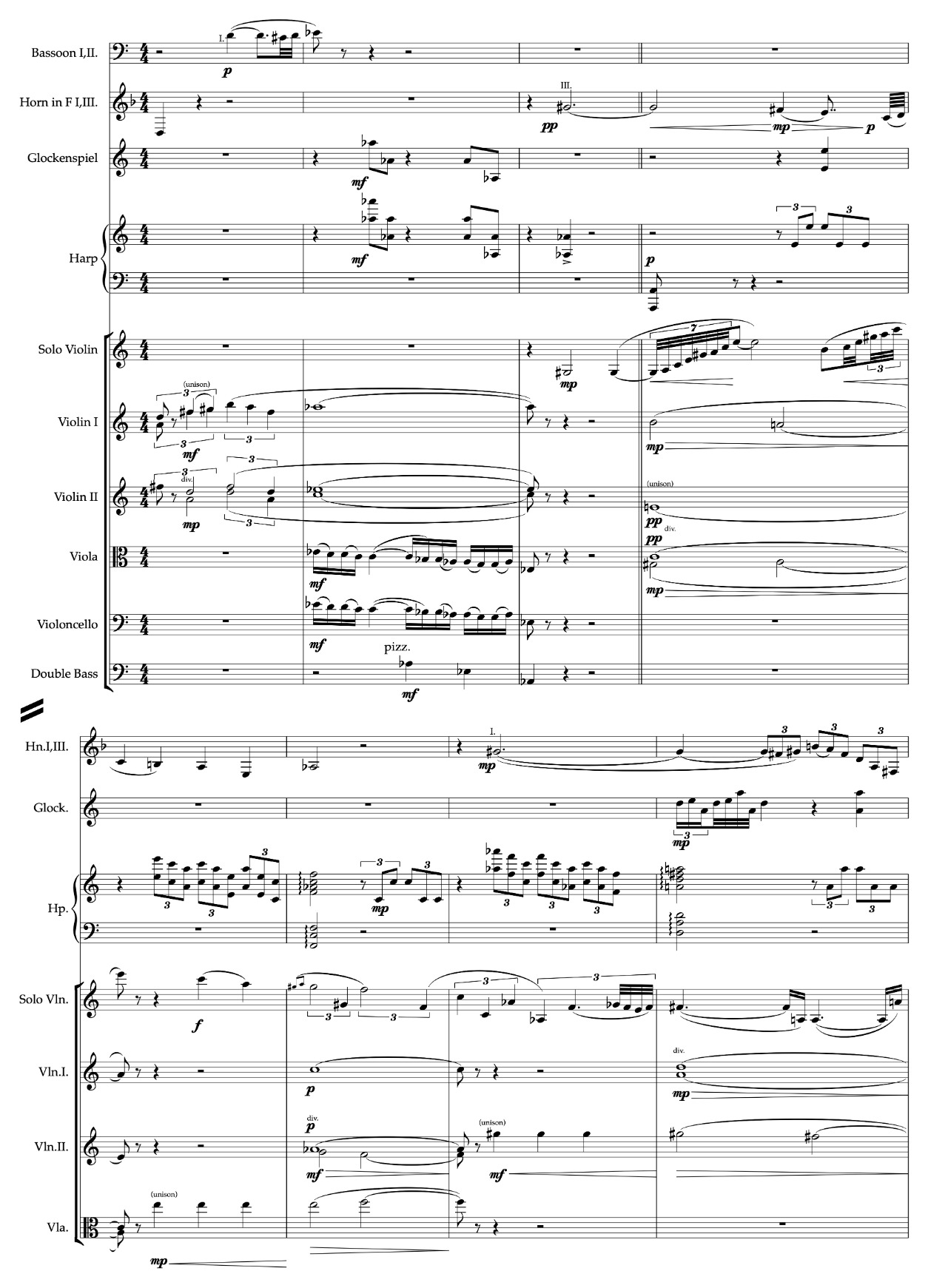
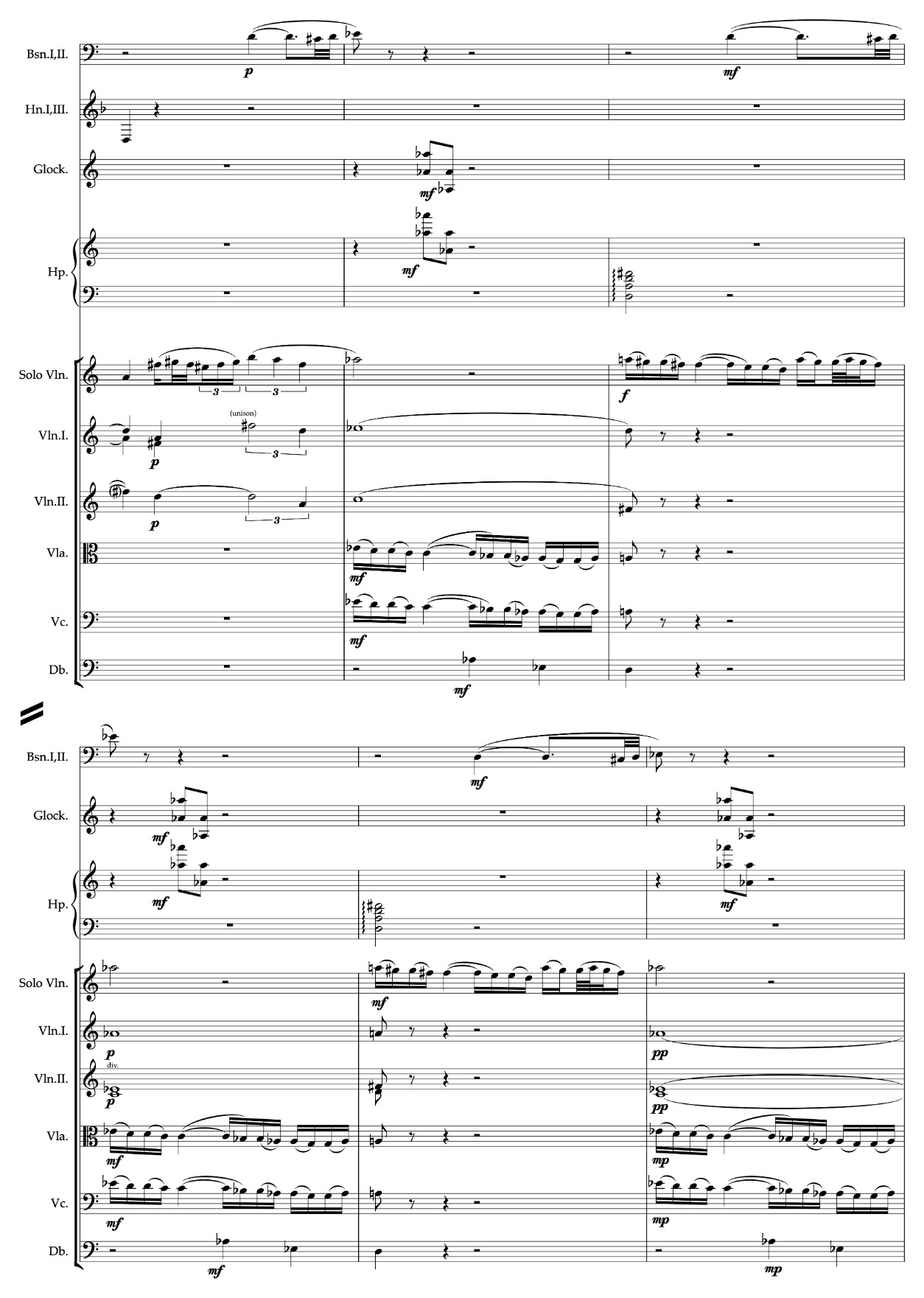
4. Theme B: the solo violin takes the lead (bars 22–31)
Theme B begins in the solo violin at bar 22 with the seven-note figure G♯–G♯–F♯–G♯–A–E–F♯. Its broad melodic line continues to bar 29, reversing the previous relationship between ensemble and soloist: the violin now carries the theme above changing orchestral harmonies.
The sustained melody contrasts with Theme A’s shorter appoggiaturas. Beneath it, the harp moves from A♭ major to A minor at bar 22 and F♯ major at bar 23, followed by D-major, C♯-minor and related colours. These are passing harmonic regions, not a succession of established tonal centres.
A distinctive bassoon figure closes Theme B at bars 30–31. The composer recalls that Volker Hartung initially took it for a Kurdish traditional melody, although the figure is original. Its return after the second statement of Theme B gives the two presentations a corresponding close.
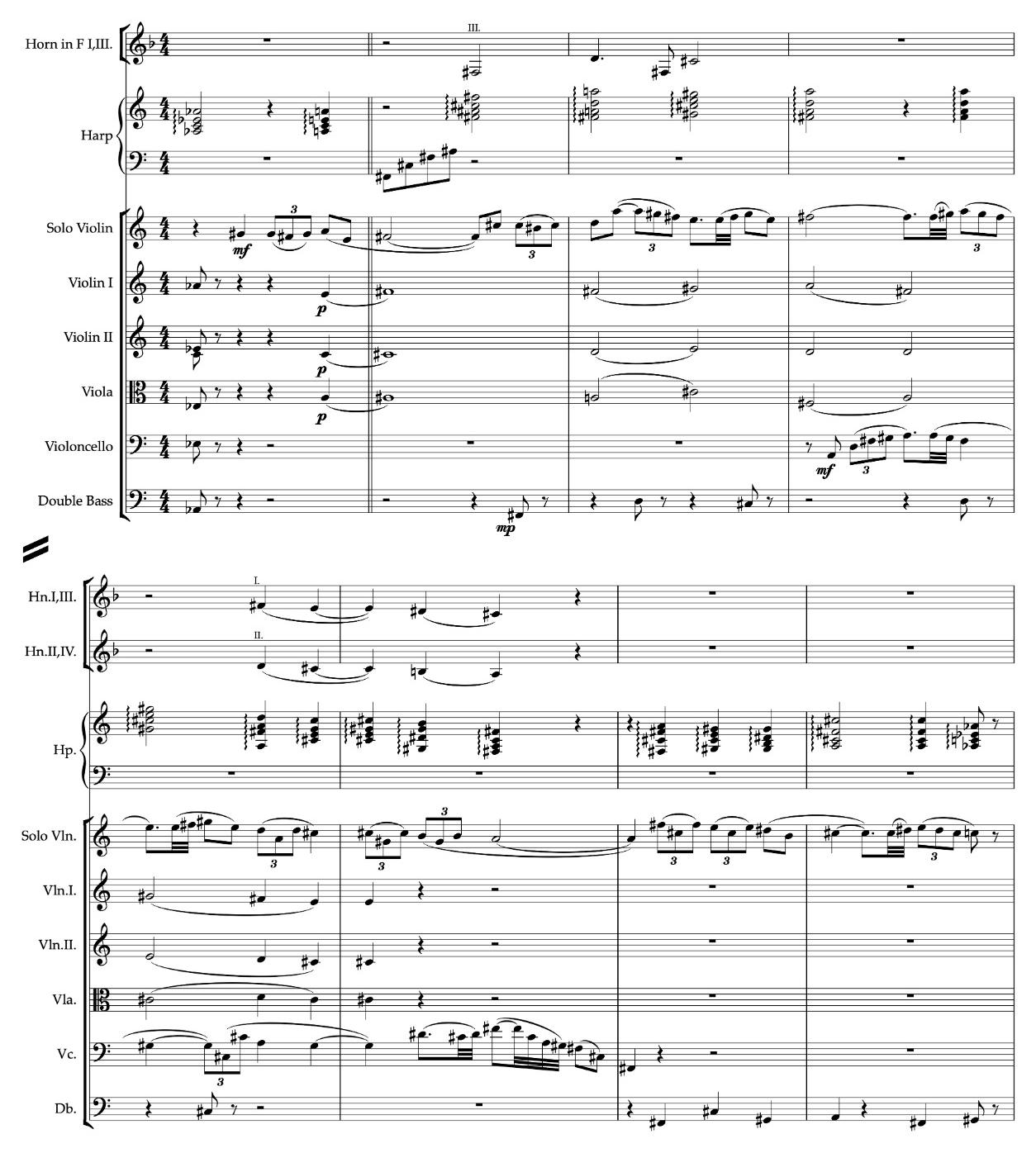
5. Theme B enlarged: the orchestral climax (bars 32–39)
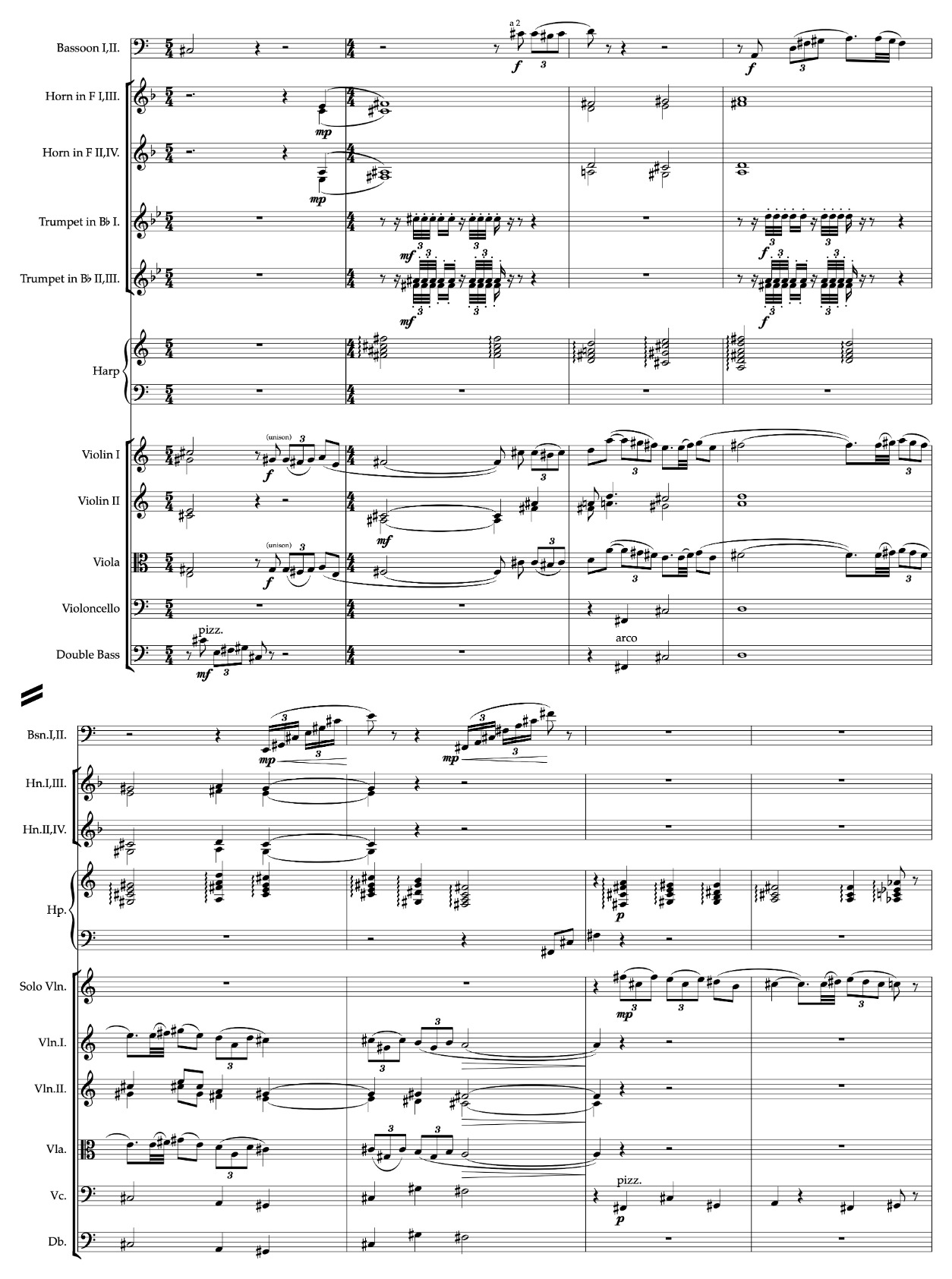
Theme B returns at bar 32, carried chiefly by orchestral Violin I and violas. The opening measure expands to 5/4; a fuller forte texture gives the melody a breadth and intensity absent from its first appearance. The harmony remains related, but register, doubling and instrumental activity transform the expression.
The solo violin rests as the orchestra develops the theme through bars 32–37. Repeated trumpets, active inner strings and horn responses increase the intensity. The soloist returns at bar 38 to complete the phrase in bar 39. An individual melody has become a collective statement before passing back to the violin.
For the composer, this is the movement’s emotional climax and possibly the concerto’s. Unlike the contrapuntal culmination of the first movement at bar 310, its force comes from the breadth of a single lyrical theme shared by the orchestra.
6. Closing motif and transition (bars 40–52)
The bassoon figure reappears at bars 40–41, matching the close of Theme B’s first statement and opening the transition. The metre moves from 5/4 back to 4/4 as the theme gives way to the coda.
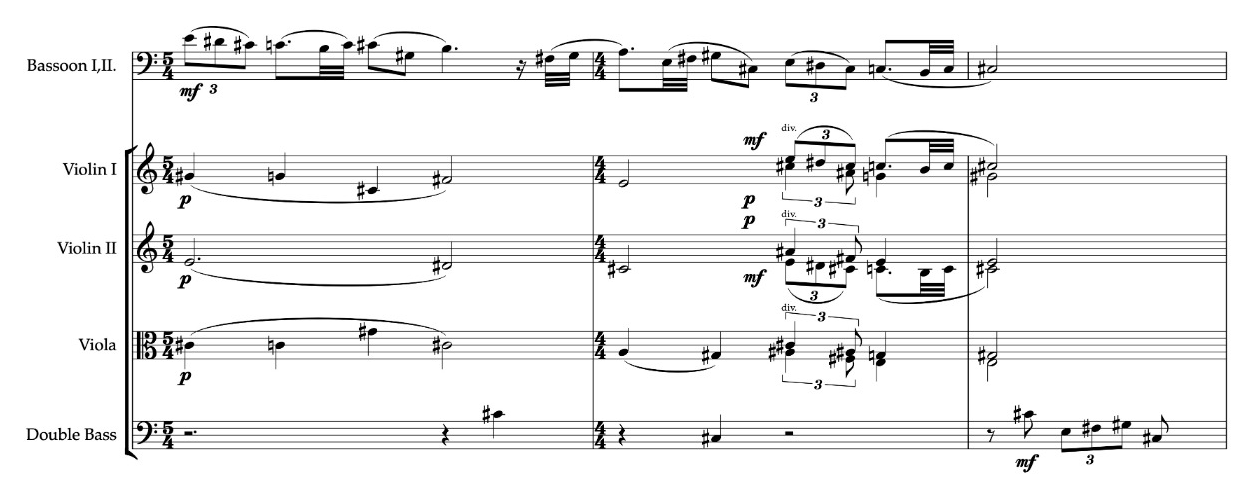
The solo violin returns at bar 42 with shorter gestures over sustained horns and bass notes. A high-register flourish at bars 45–46 briefly intensifies the texture; harp and glockenspiel restore the movement’s luminous colour. The change to 3/8 at bar 49 compresses the gestures and prepares the close.
The attacca connection recalls the passage from slow movement to finale in Mendelssohn’s E-minor Violin Concerto, although no melodic borrowing is implied. Here the coda was composed before the finale, and the later harmonic relationship between the movements emerged retrospectively.
7. A semitone changes the ending (bars 53–60)
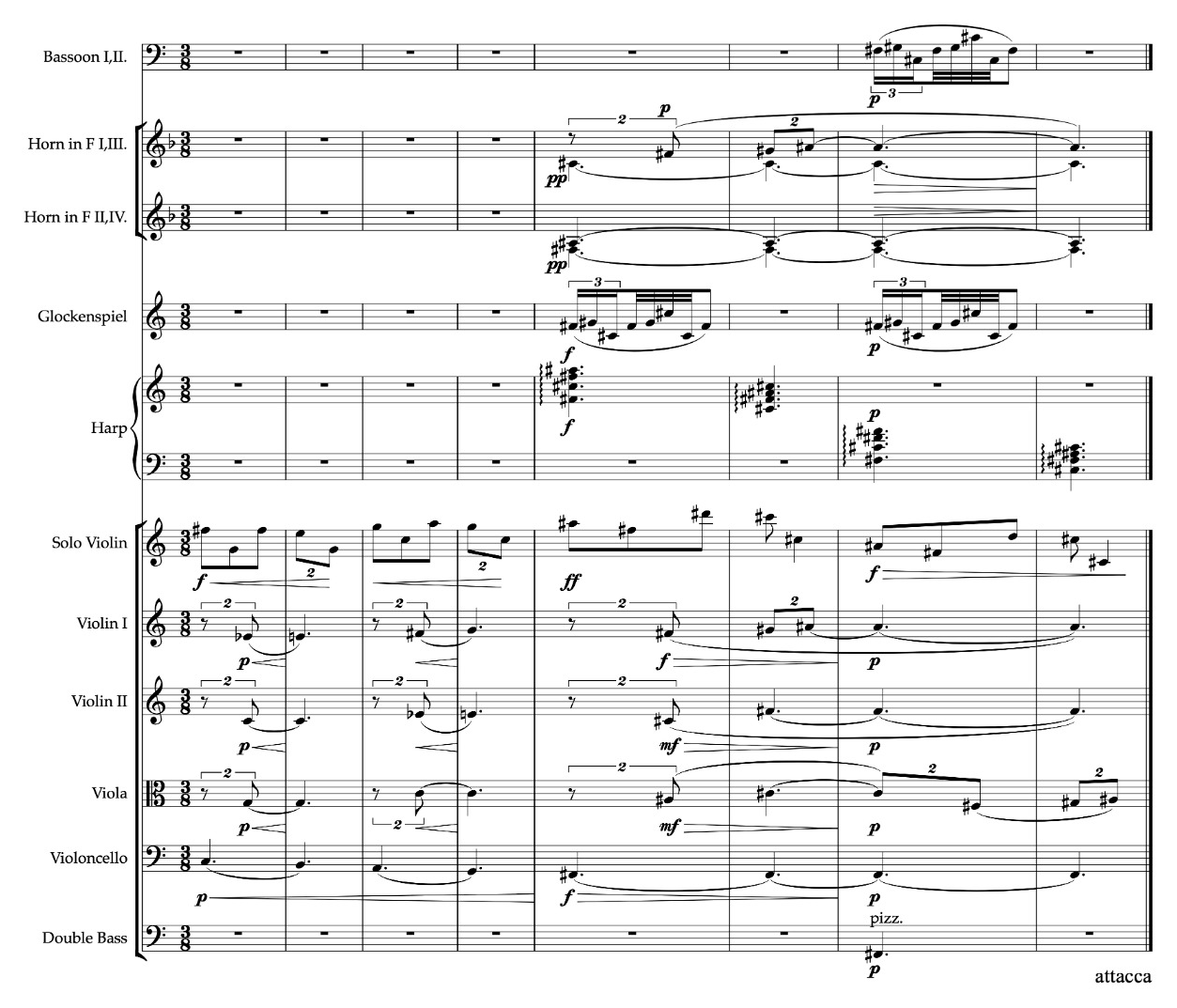
The cello bass descends C–B–A–G–F♯ through bars 53–57. Above it, chromatic harmonies move from C-minor colour through C major over B and a diminished-seventh collection over A, arriving on F♯ without a conventional dominant–tonic cadence.
Over F♯-major harmony at bar 57, the solo violin plays A♯–F♯–D♯, outlining D♯ minor. When the gesture returns in a lower register at bar 59, D♯ becomes D natural: A♯–F♯–D. This forms an augmented triad against the continuing F♯-major colour. The single semitone alteration turns what the composer hears as an affirmative phrase into one of inward contemplation.
The starlit imagery of the later title is especially apt here. Against glistening harp and glockenspiel, the violin withdraws into a quieter register. Yet the expressive change is achieved musically—through a single altered pitch—rather than through any literal depiction.
8. Completion and the connection to the finale
A recording dated 16 February 2014 contains all the main themes, while orchestration was still underway in January 2017. The July 2016 Part II sketch shows an early orchestral form linked to the emerging finale; a separate score of the slow movement is dated 28 November 2017. The surviving sources reveal a long interval between melodic conception and orchestral completion.
The movement closes in an F♯-major region; the finale opens in D major, and the two harmonies share F♯. The violin’s D natural at bar 59 also anticipates a pitch central to the finale’s opening. Because the slow movement’s ending was composed first, these connections are retrospective: the altered D originally served an expressive purpose within the slow movement itself.
Conclusion — from private reflection to shared expression
The movement’s drama lies in the transfer of themes between ensemble and soloist. Theme A allows the violin to emerge from an orchestral texture; Theme B travels from an individual voice to a broad collective climax. A recurring bassoon phrase links its statements, while the coda restores the reflective colours of the opening. The final D♯–D change condenses that expressive journey into a single semitone.
Movement III — Finale
Contrast, recognition and a collective conclusion
The movement in outline
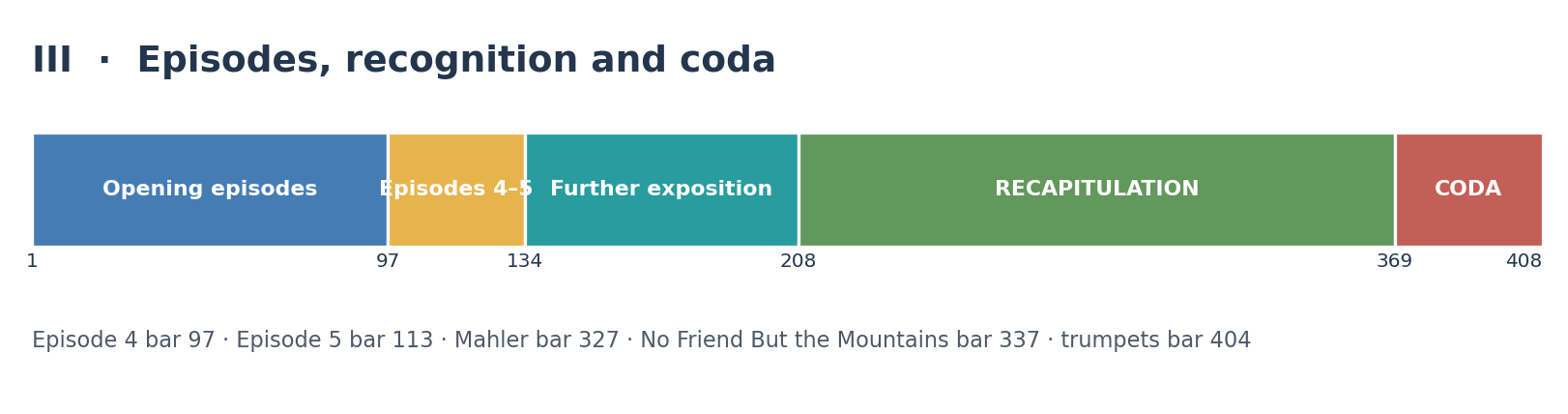
The 408-bar finale proceeds from a succession of contrasting episodes towards an extended return of earlier material. Its melodic, rhythmic and modal ideas are later recognised in new keys and orchestral settings, often with their original contours intact. This process creates an effect akin to the reassurance of rondo form, although the movement does not follow a regular rondo scheme.
From experimental sketch to completed finale
The July 2016 Part II manuscript joins the slow movement to an unfinished finale. At measure 64, the first five solo-violin measures correspond in pitch to the later independent opening. Two large spans, measures 77–114 and 125–176, remain unwritten; other ideas were subsequently relocated or recomposed. The score preserves a formative stage, not a continuous finished movement.
The July 2016 sketch marks the opening Adagietto at minim = 90 and the Allegro at crotchet = 132. The August–October 2017 score gives minim = 70 and crotchet = 140; the revised 2024 score retains minim = 70 and marks the Allegro at crotchet = 120. These changing indications reveal the reconsideration of the movement’s pacing alongside its formal development.
The 414-bar score of August–October 2017 already contains most of the definitive architecture, but its coda is relatively rudimentary and the Mahler Eighth quotation is absent. According to the composer, a demonstration dated 28 November 2017 preserves the fully orchestrated finale with both elements in place. The decisive revisions were therefore completed by late November, before the Cologne premiere.
The revised 2024 score incorporates only minor post-premiere alterations. The finale’s structure was already definitive in 2018.
1. Introduction and thematic identity
The finale begins with vigorous solo-violin figuration. The theme later identified as No Friend But the Mountains introduces a more sustained melodic character. The shifting emphasis between soloist and orchestra establishes a relationship that shapes the entire movement.
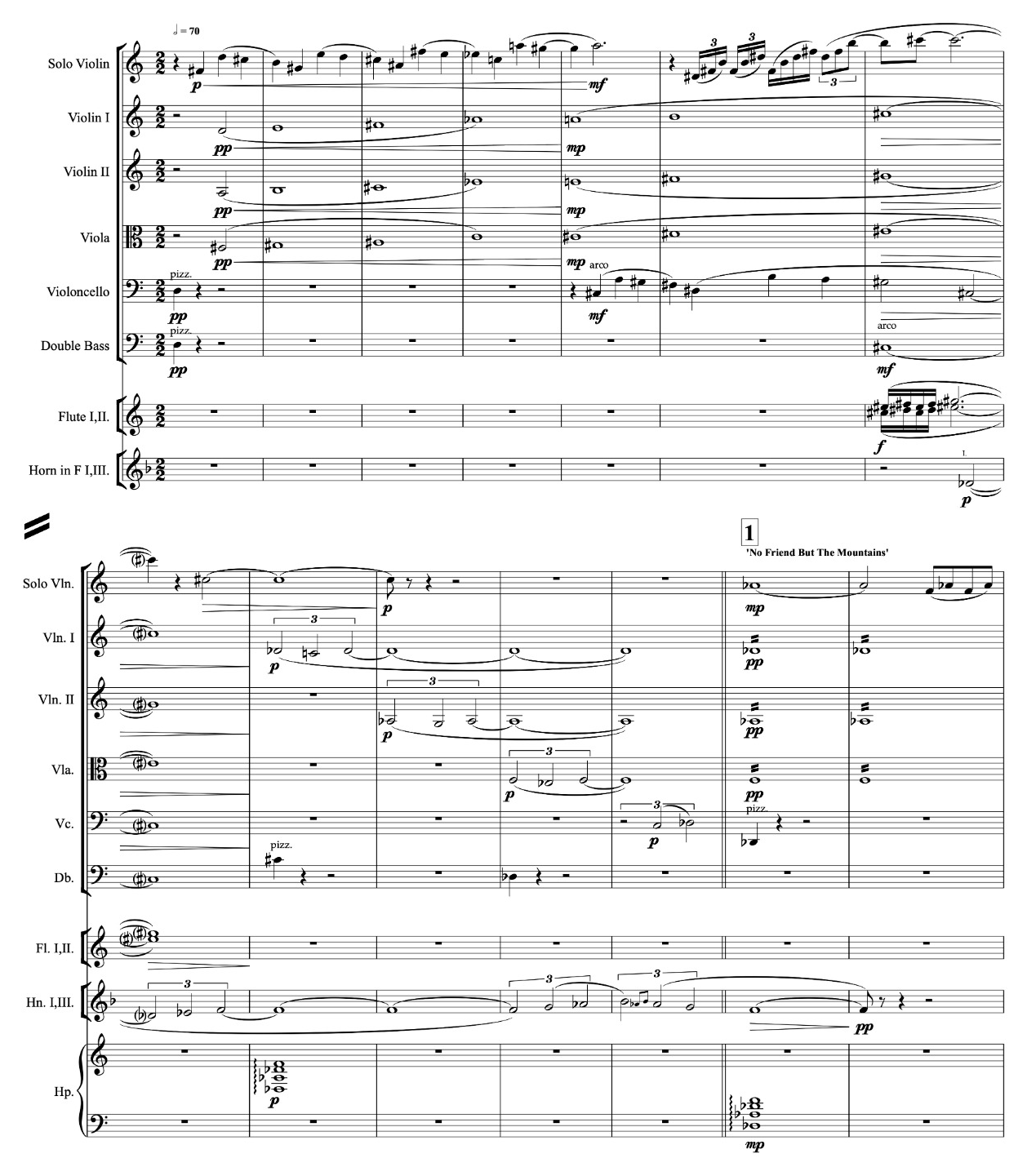
Example 1a. Opening of the finale, bars 1–12 (reduced score).
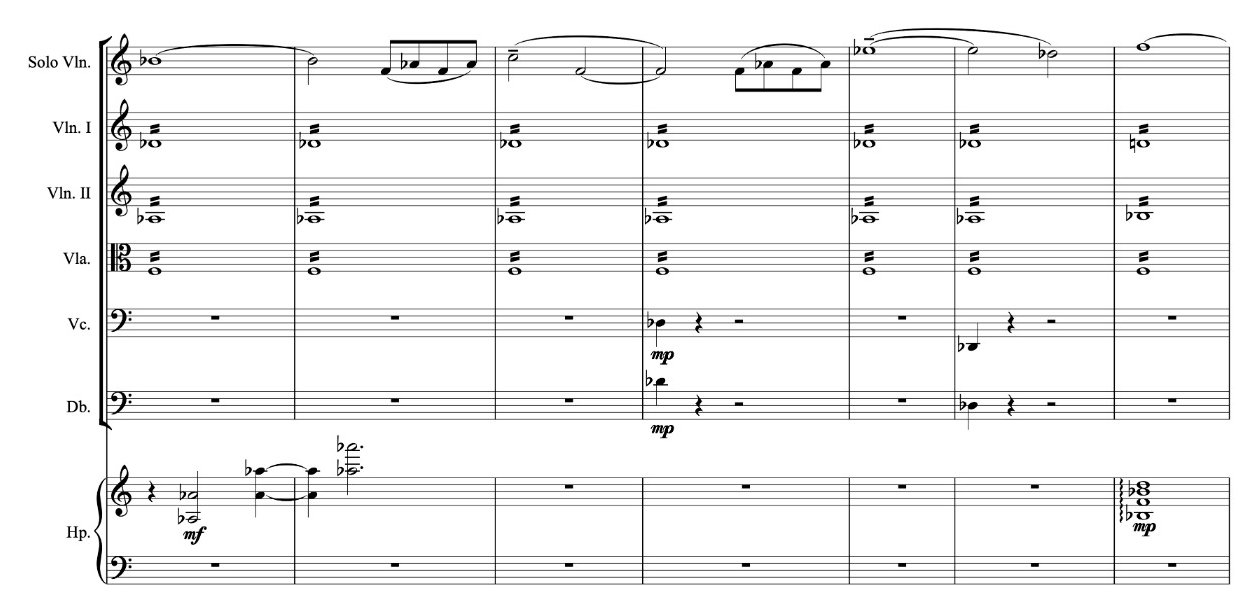
Example 1b. Continuation and entrance of No Friend But the Mountains, to bar 20.
2. Melodic sequence and plagal harmony
At bars 45–64, three related melodic statements unfold above plagal harmonies. Their shared contour makes the sequence easy to follow, while each statement alters the melodic direction or register. A transparent accompaniment keeps the thematic process audible.
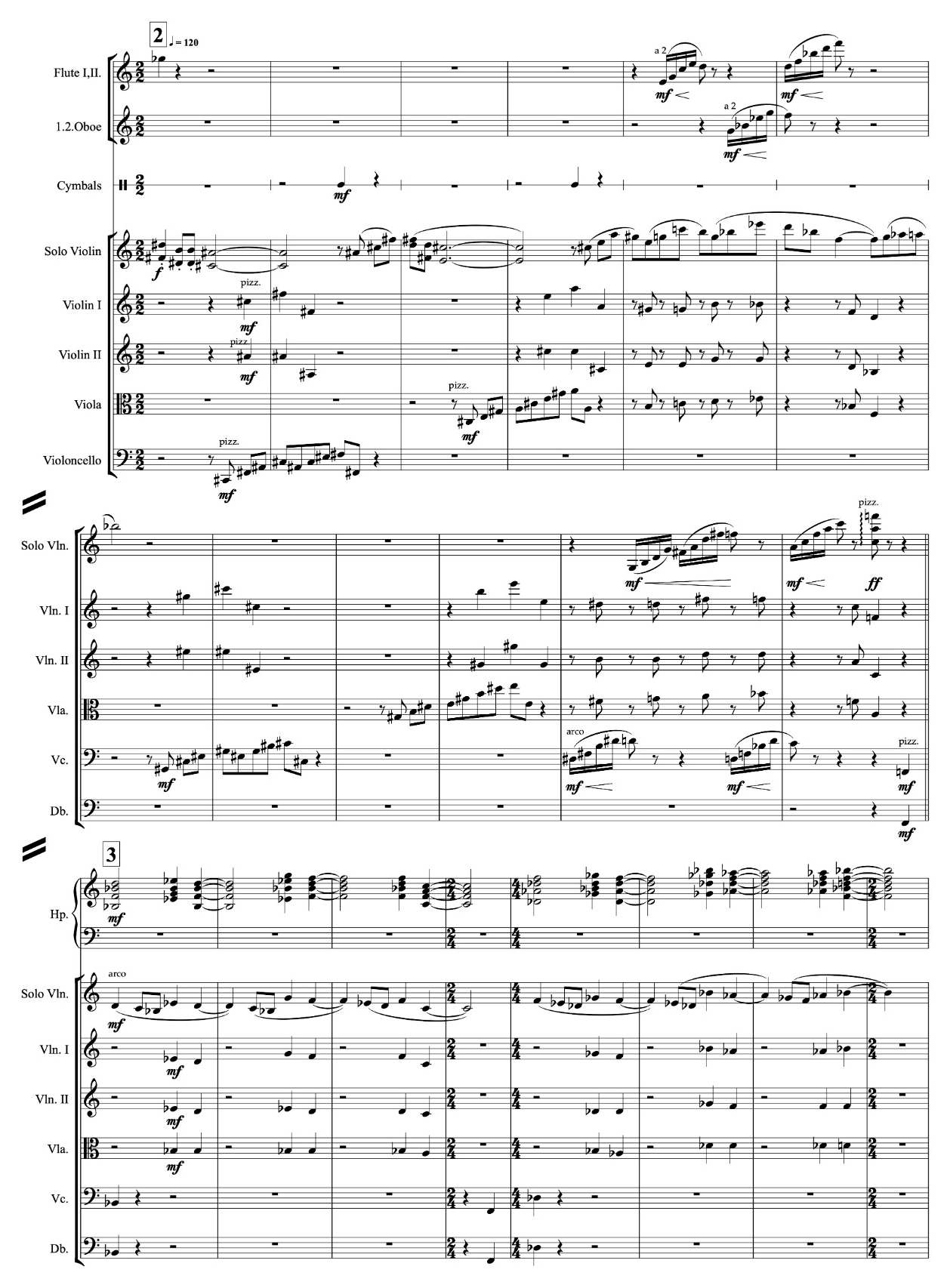
Example 2. Melodic sequence and orchestral texture, bars 45–64.
3. Syncopation and modal colour (bars 97–112)
At bar 97, the solo violin introduces a highly syncopated melody opening on D♭, a lowered-tonic inflection against D minor. Related G♯/A♭ colour appears around bar 105 in an A-minor region. Beneath the soloist, ascending appoggiaturas in violas and cellos replace the preceding texture with continuous motion. Rhythm, altered scale degrees and orchestration combine to create the episode’s distinctive modal character.
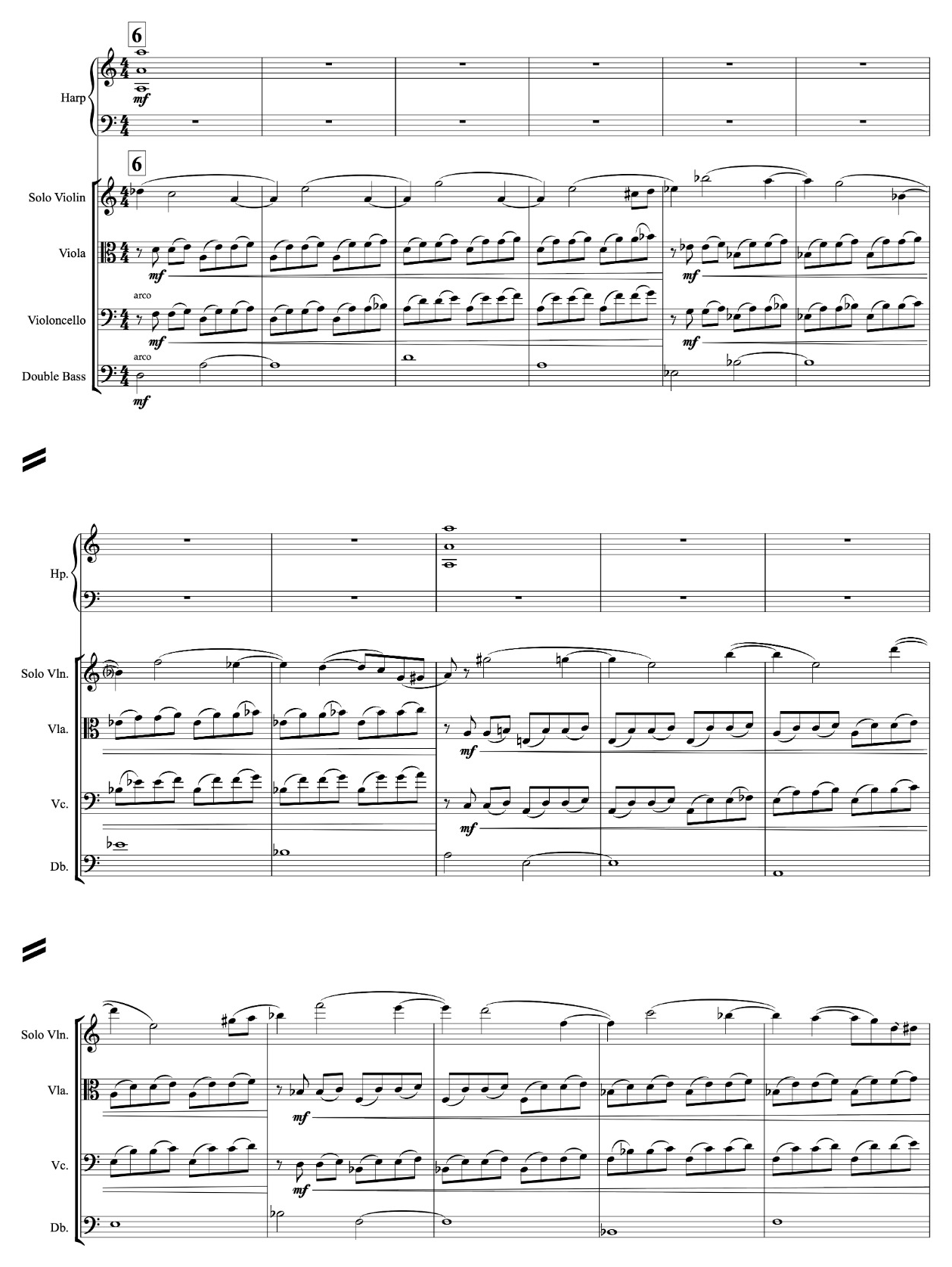
Example 3. Episode 4, bars 97–112: syncopated modal melody over ascending lower-string appoggiaturas.
4. First large climax (bars 113–133)
The episodic opening reaches its first large climax at bars 113–133. A principal melody moves from orchestral Violin I at bar 113 to Trumpet I at 117, then to the solo violin at 121. Brilliant ascending figures surround the successive statements, but the melodic handover provides their direction. Each transfer increases the passage’s orchestral weight.
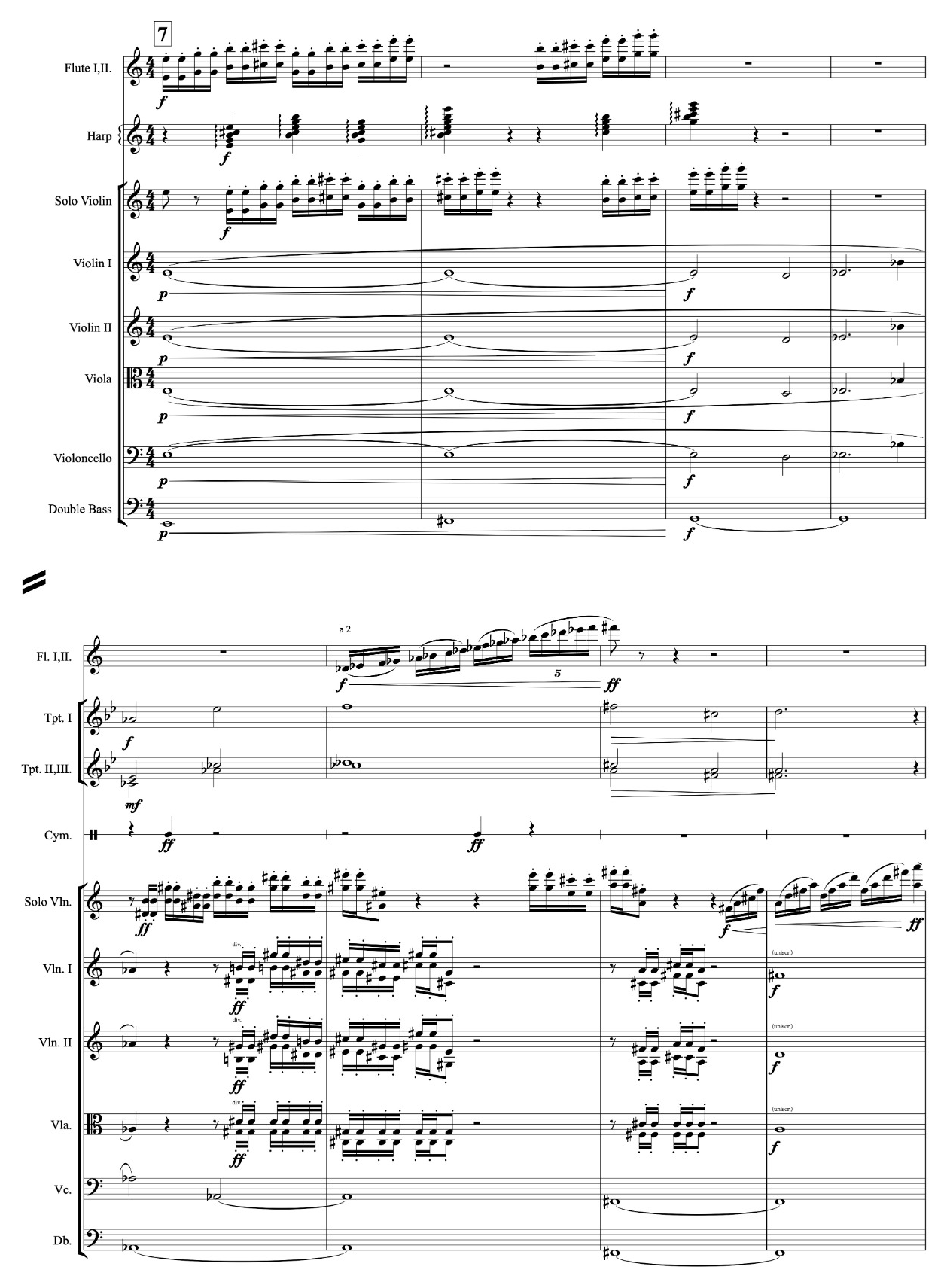
Example 4a. Episode 5: principal melody introduced in Violin I and transferred to trumpet.
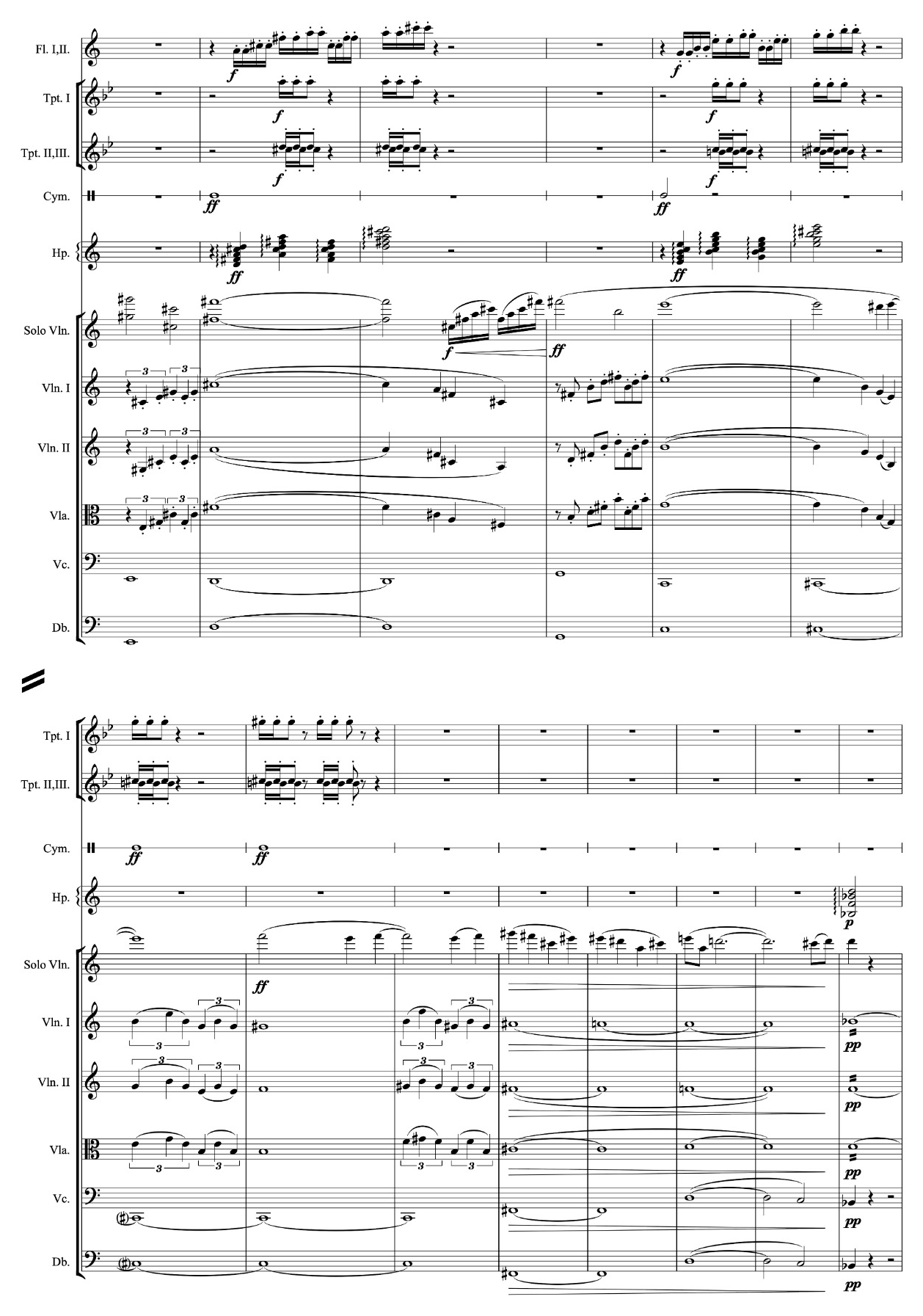
Example 4b. Episode 5 to bar 133: culmination of the instrumental handover.
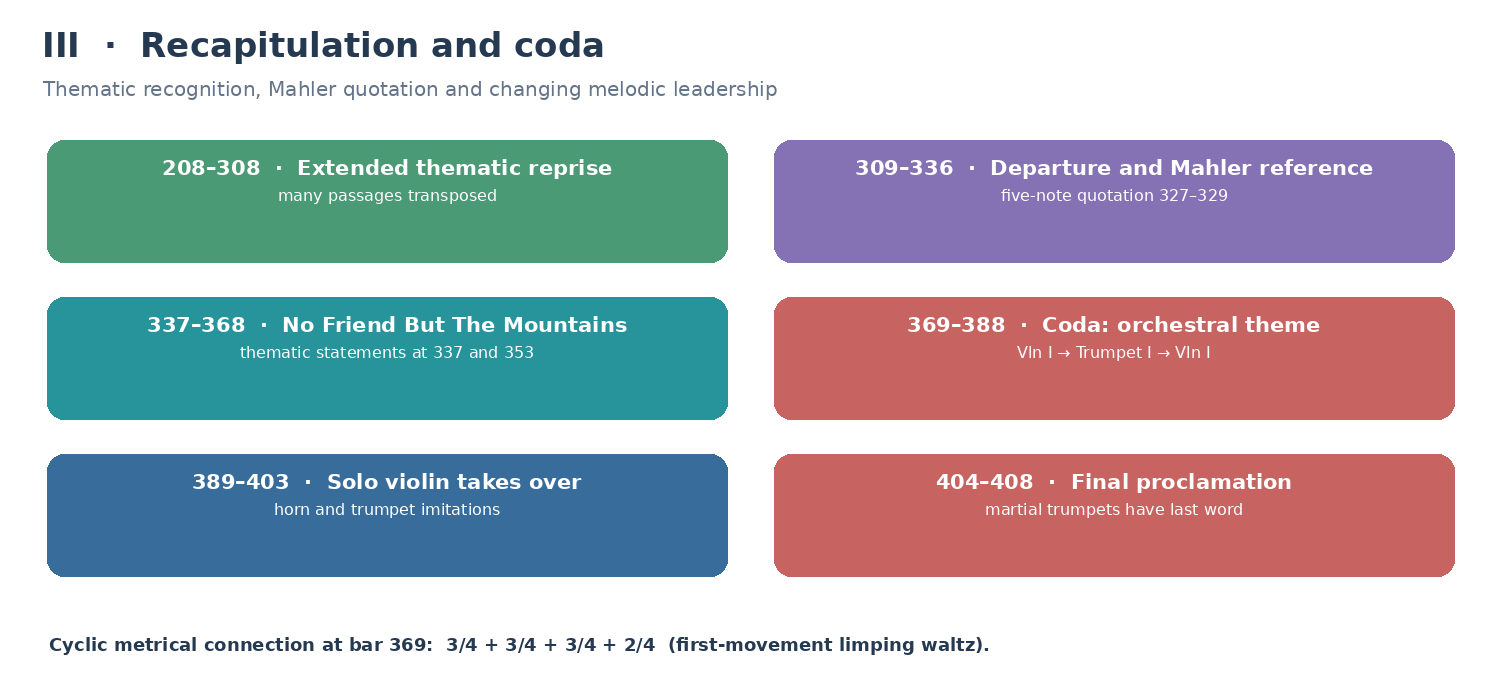
After the climax at bar 133, a contrasting passage delays the return of earlier material until bar 208. The intervening variety makes the recapitulation’s recognisable themes more telling.
Figure 5. Finale: thematic returns, Mahler quotation and coda handovers.
5. Extended recapitulation (bars 208–368)
The recapitulation begins at bar 208 and ends before the coda at 369. From about bar 218, much of the solo violin’s earlier material returns a major second higher. The melody from bar 57, for example, reappears at bar 220 with its rhythm and intervallic shape largely preserved.
The listener can now anticipate melodic patterns heard earlier. Transposition and new orchestral surroundings renew their colour without obscuring their identity; the pleasure of recognition gives the movement its rondo-like character.
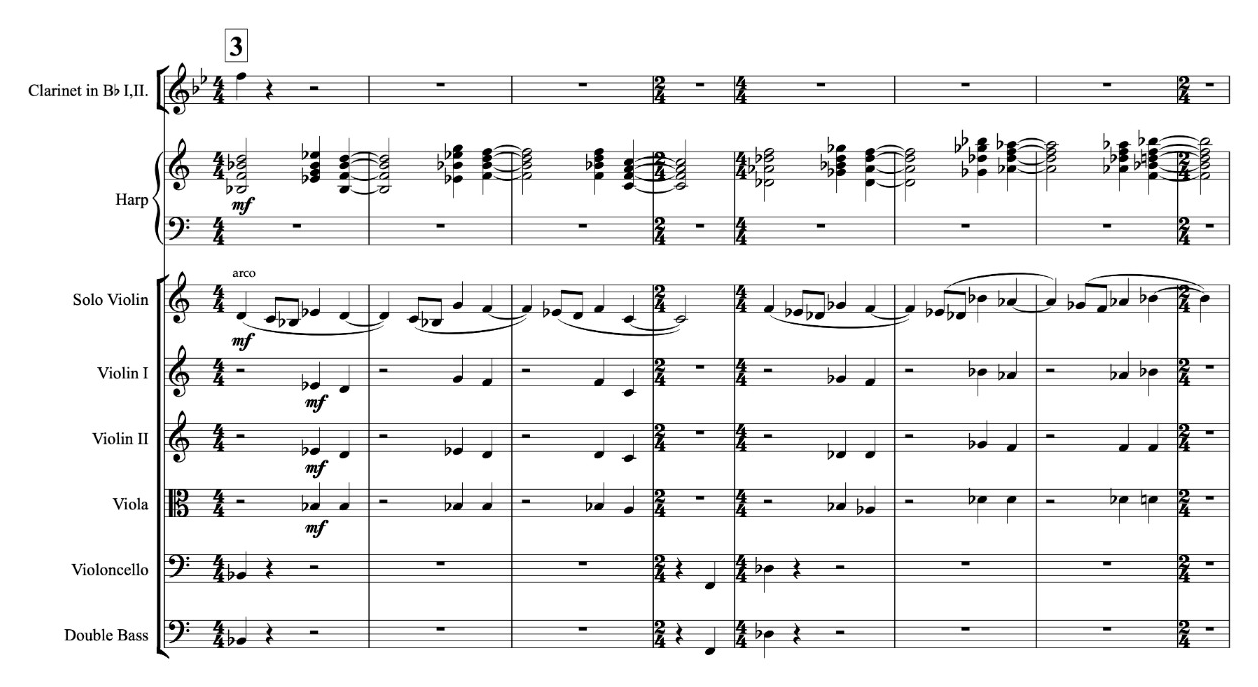
Example 5a. Original melodic statement, bars 57–64.
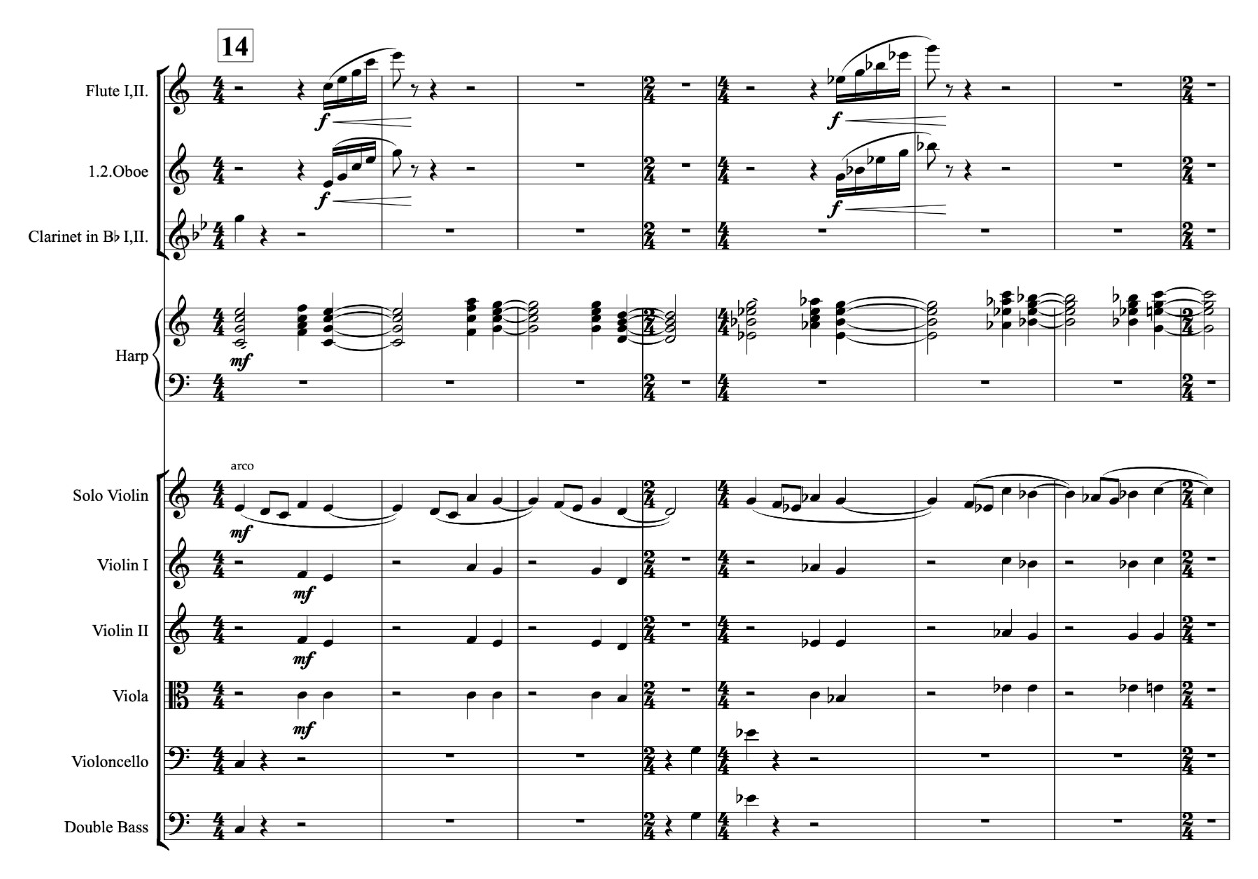
Example 5b. Recapitulation, bars 220–227: corresponding melody a major second higher.
6. The Mahler quotation (bars 320–336)
In the second half of bar 320, the solo violin begins an expressive phrase on E♭. Within the extended codetta around bar 324, the composer introduces a direct quotation of “Noch blendet ihn der neue Tag” from the closing scene of Mahler’s Eighth Symphony. The solo line continues through C♭–A♭–E♭–F–G♭ in bars 327–329, integrating the allusion within the surrounding melodic argument.
The allusion enters the concerto’s own melodic argument rather than interrupting it. A listener familiar with Mahler may hear an additional association with the themes of transformation and redemption in Goethe’s Faust; for Webb-Mitchell, the quotation also pays personal homage to a composer whose music profoundly shaped his imagination.
The Mahler quotation was absent from the August–October 2017 finale but present by the 28 November demonstration. The surrounding music was also recomposed, integrating the borrowed phrase within the recapitulation rather than appending it as an external reference.
Sustained strings support the quotation, and the solo violin’s G♭ participates in the major sonority that follows. The phrase thus belongs to the ongoing harmonic progression as well as to the work’s wider field of reference.
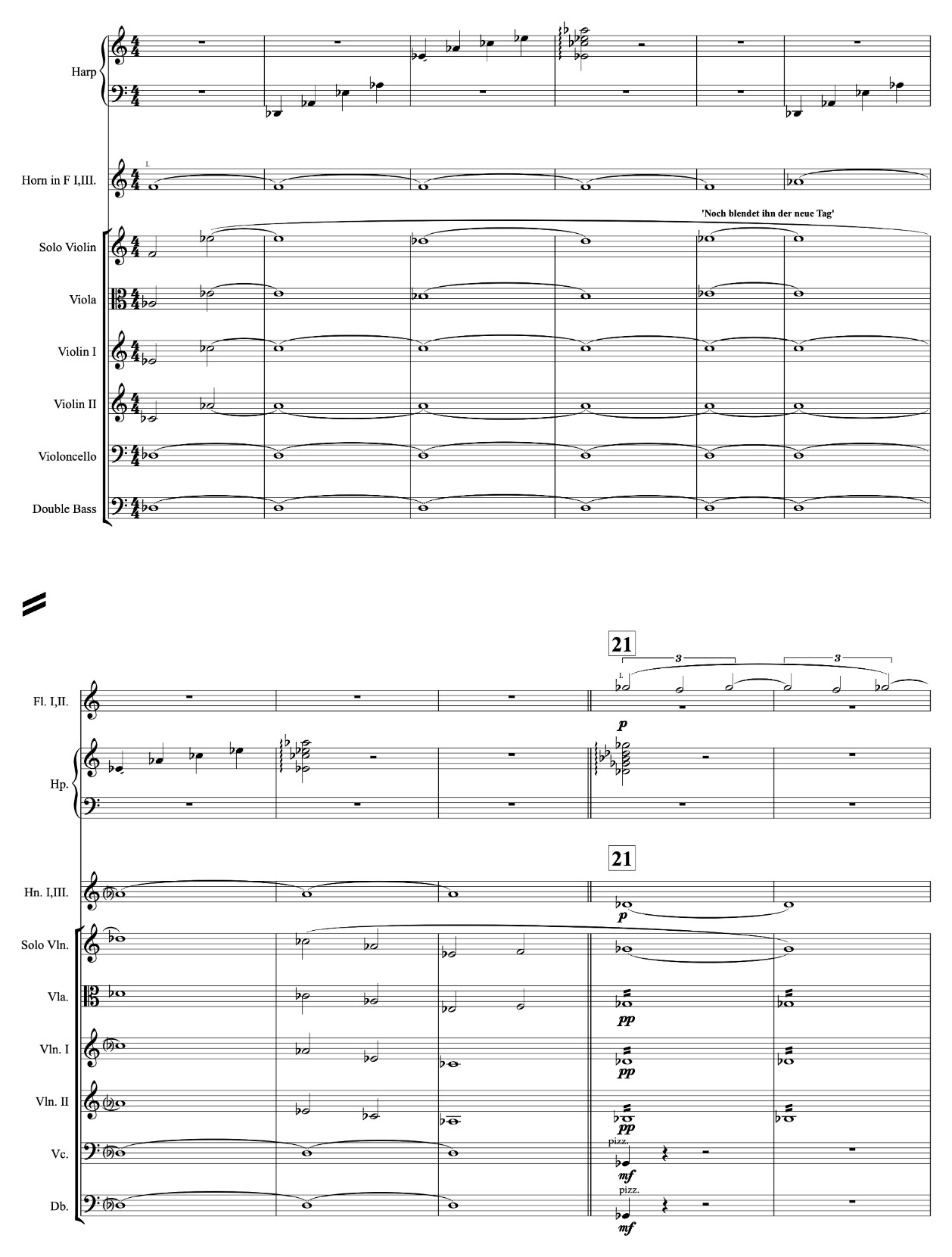
Example 6. Solo-violin passage containing the Mahler quotation, bars 320–330.
7. Return of No Friend But the Mountains
No Friend But the Mountains returns at bar 337 over a major-key string foundation, and again from bar 353 in another tonal setting. After the Mahler allusion, the melody restores the finale’s own thematic voice. Its recognisable contour persists through both changes of harmony and orchestration.
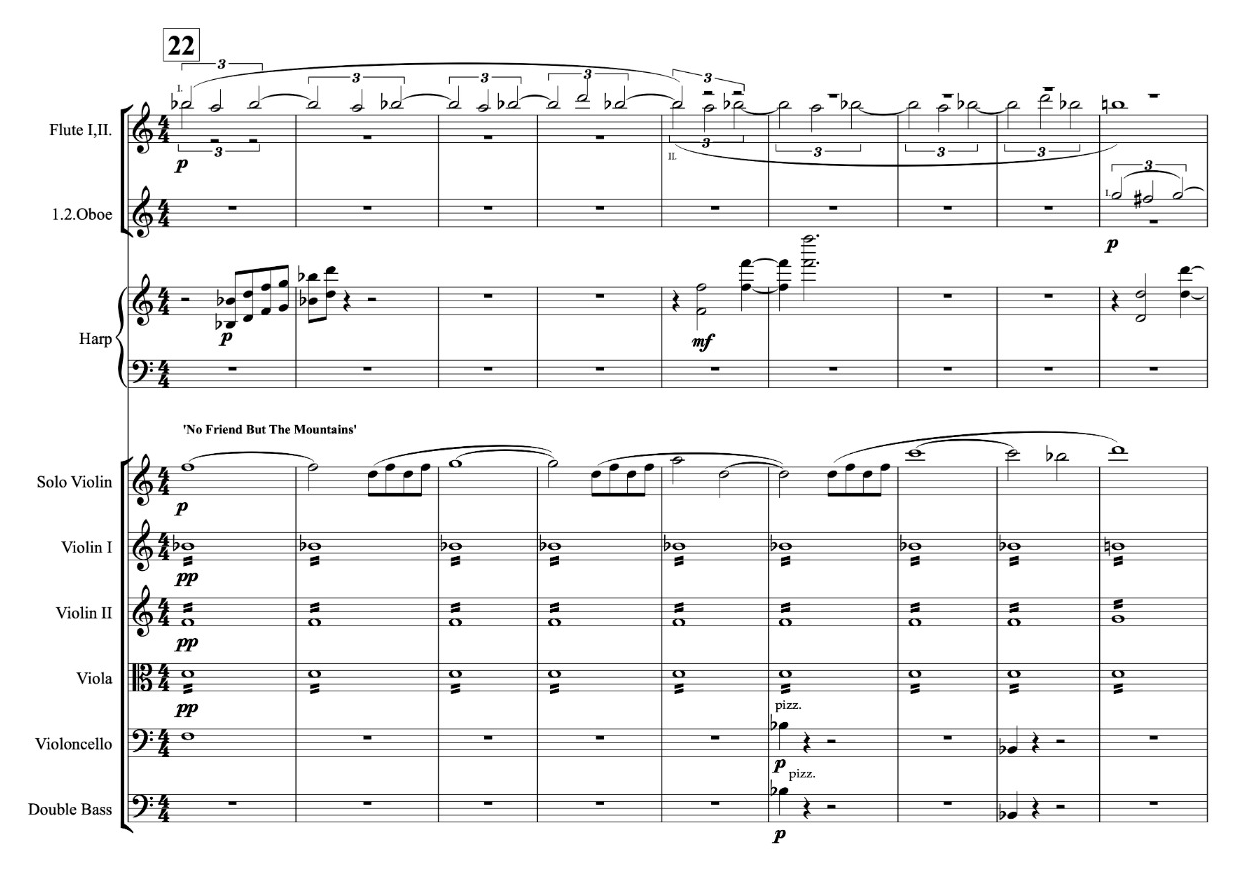
Example 7a. First return of No Friend But the Mountains, bars 337–345.
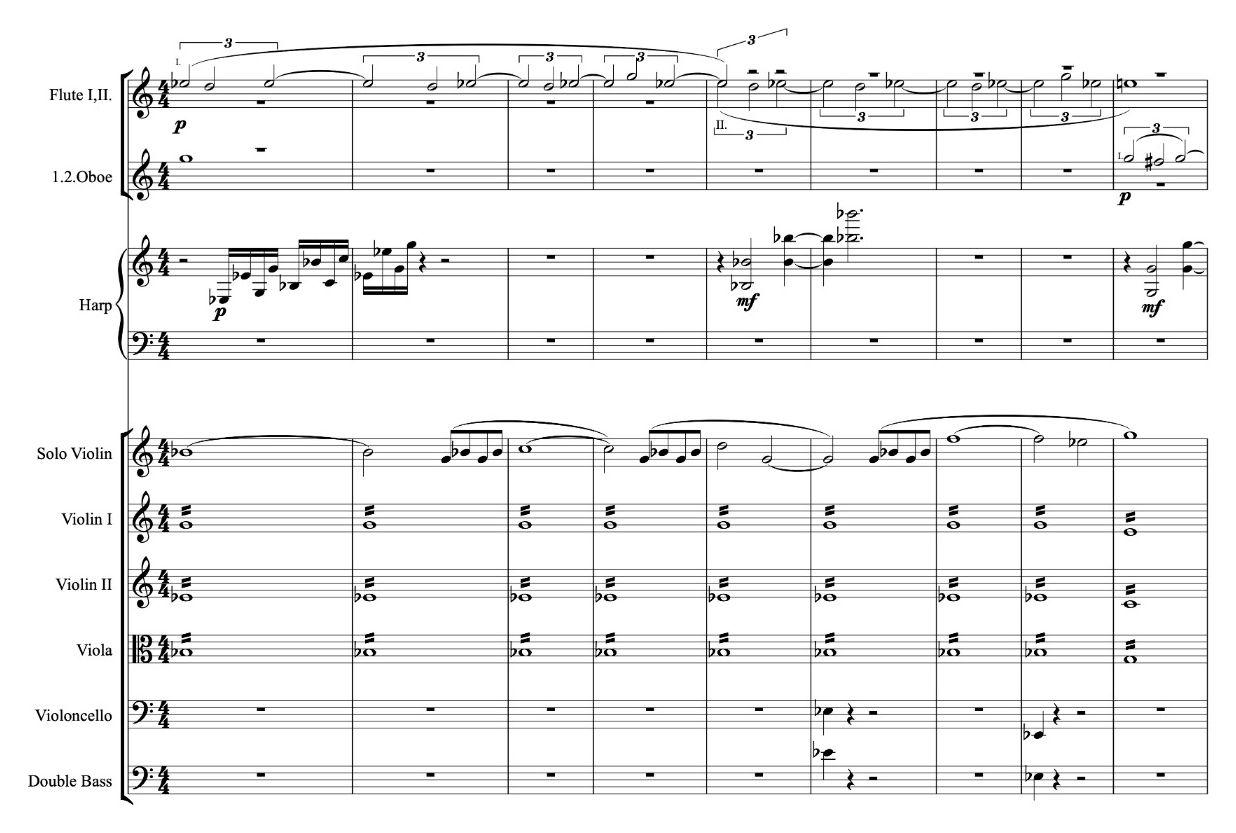
Example 7b. Subsequent statement, bars 353–361.
8. Coda (bars 369–408)
The August–October 2017 coda already contains recognisable closing material, though with a sparer, less integrated ending. By 28 November its developed orchestral conclusion was in place. The finished coda retains the earlier material while strengthening the transfer of its melody among the instruments.
The coda begins at bar 369. Orchestral Violin I states the closing melody (369–372), passes it to Trumpet I at 373 and resumes it from bar 377 towards 389. The soloist contributes brilliant figuration, but the thematic line belongs first to the orchestra. These transfers shape the ending’s dramatic progress.
The metrical cycle 3/4–3/4–3/4–2/4 recalls the first movement’s irregular waltz. This rhythmic kinship creates a link across the concerto without requiring the melodies themselves to be identical.
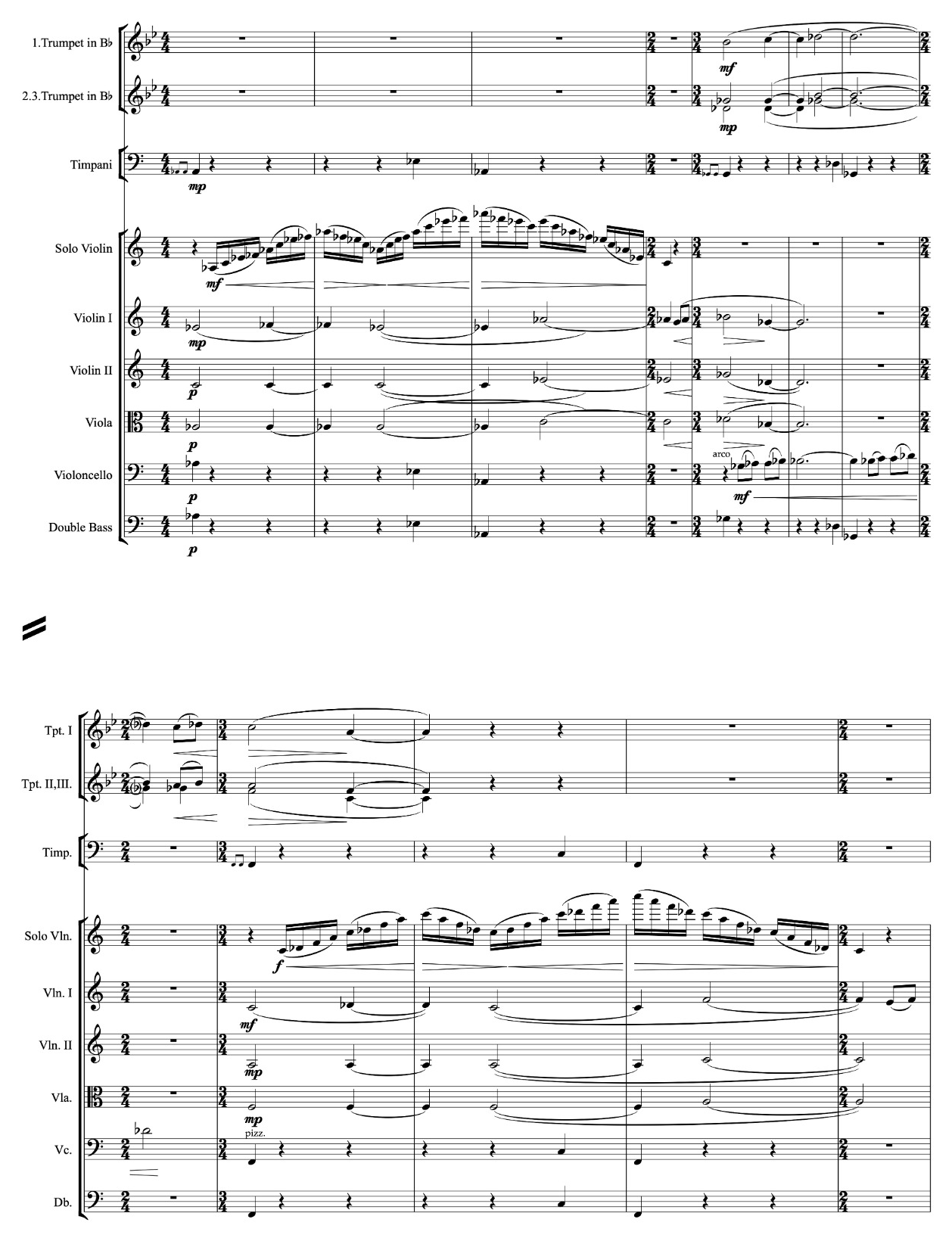
Example 8. Coda opening, bars 369–380: melody transferred between strings and trumpet.
At bar 389, the solo violin takes up the closing melody, answered by horns and trumpets. It returns at bar 396, gathering momentum towards the final passage. Both statements belong to the continuous coda beginning at bar 369.
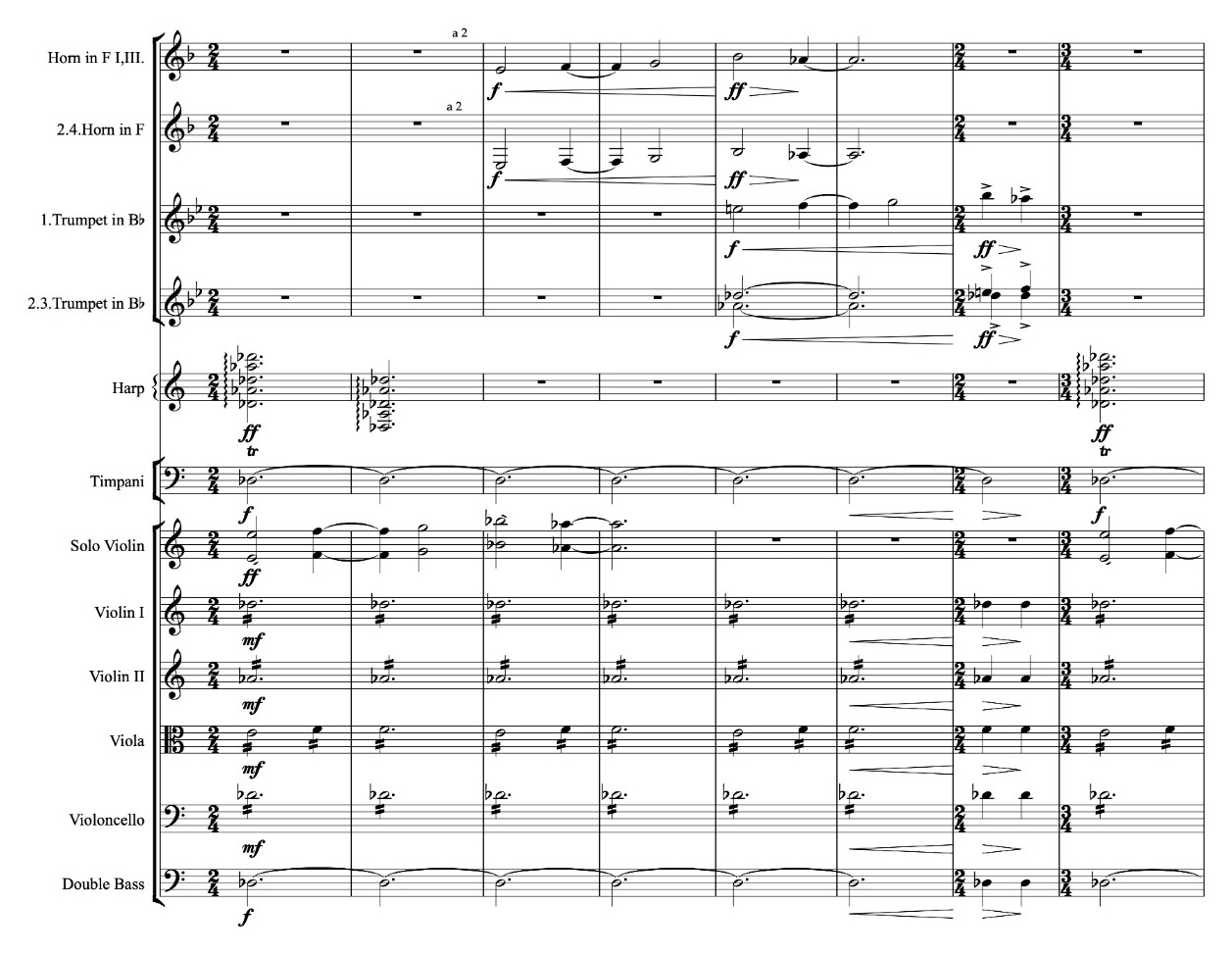
Example 9a(i). Solo-violin closing melody and brass responses, from bar 389.
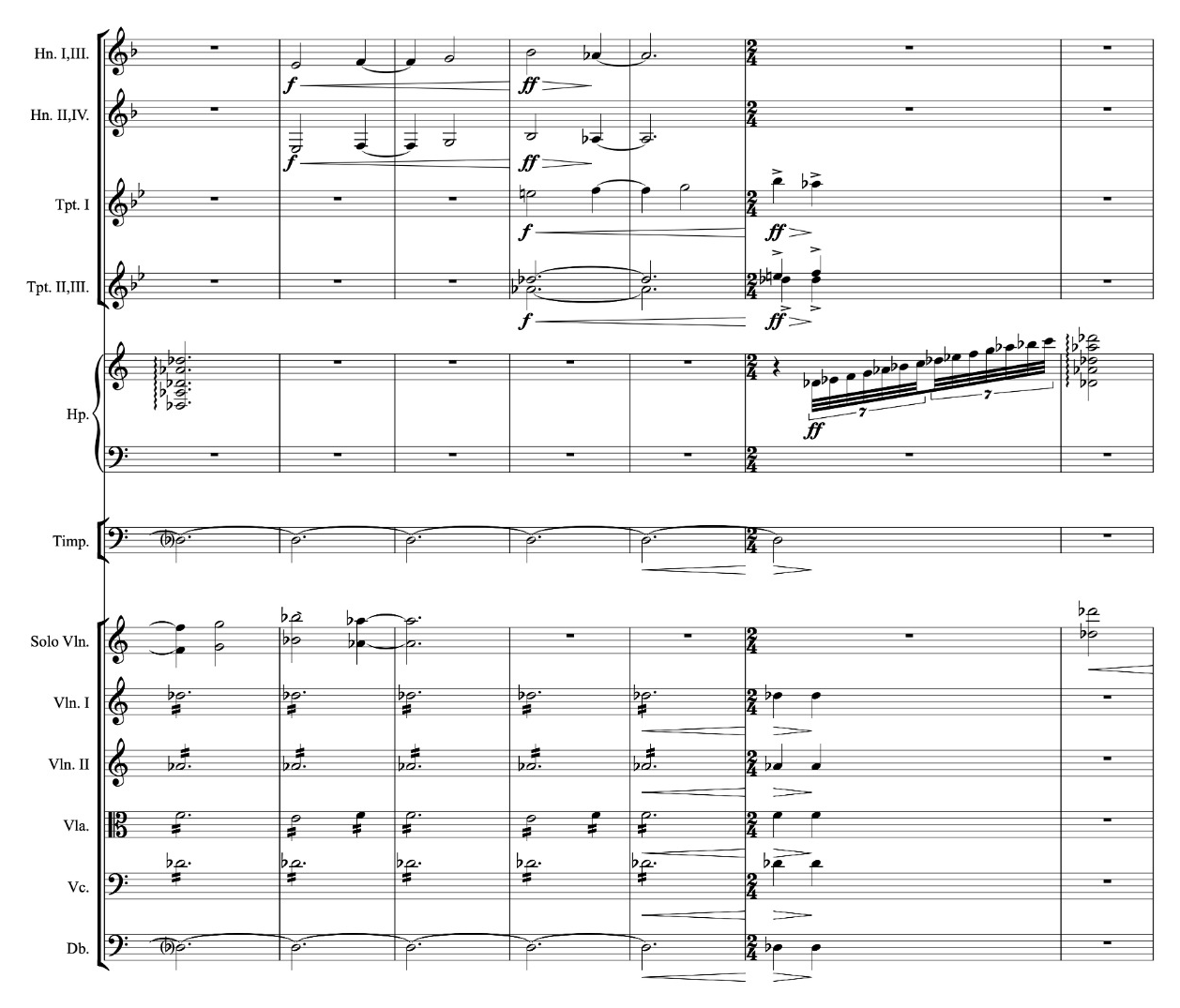
Example 9a(ii). Continuation to bar 403: repeated solo phrase and imitation.
At bar 404 the full ensemble drives towards the close. The solo violin and strings provide brilliance and motion, while the trumpets deliver the final thematic proclamation. The concerto ends in collective orchestral affirmation rather than a last display by the soloist.
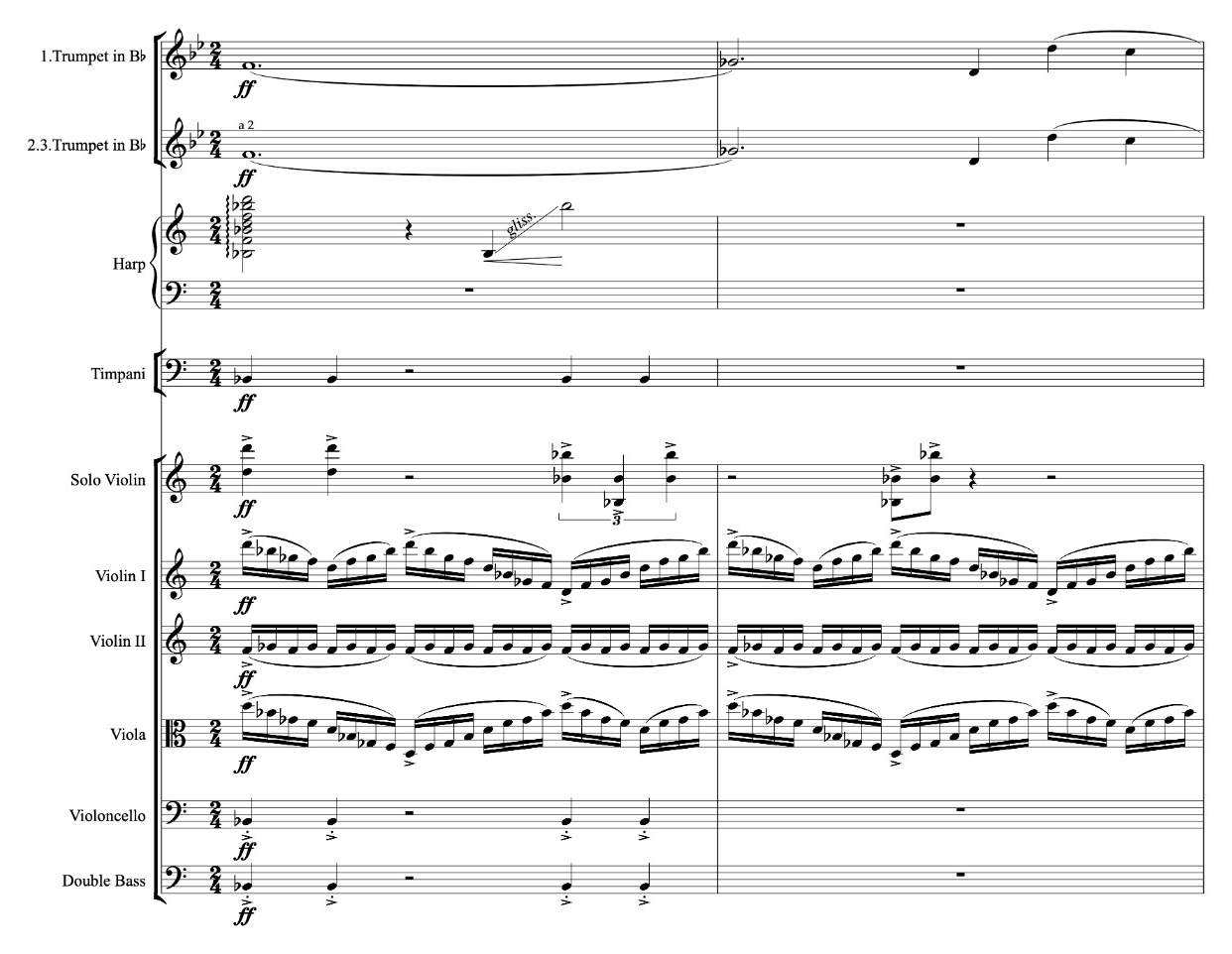
Example 9b(i). Final passage from bar 404: trumpet-led theme over active strings.
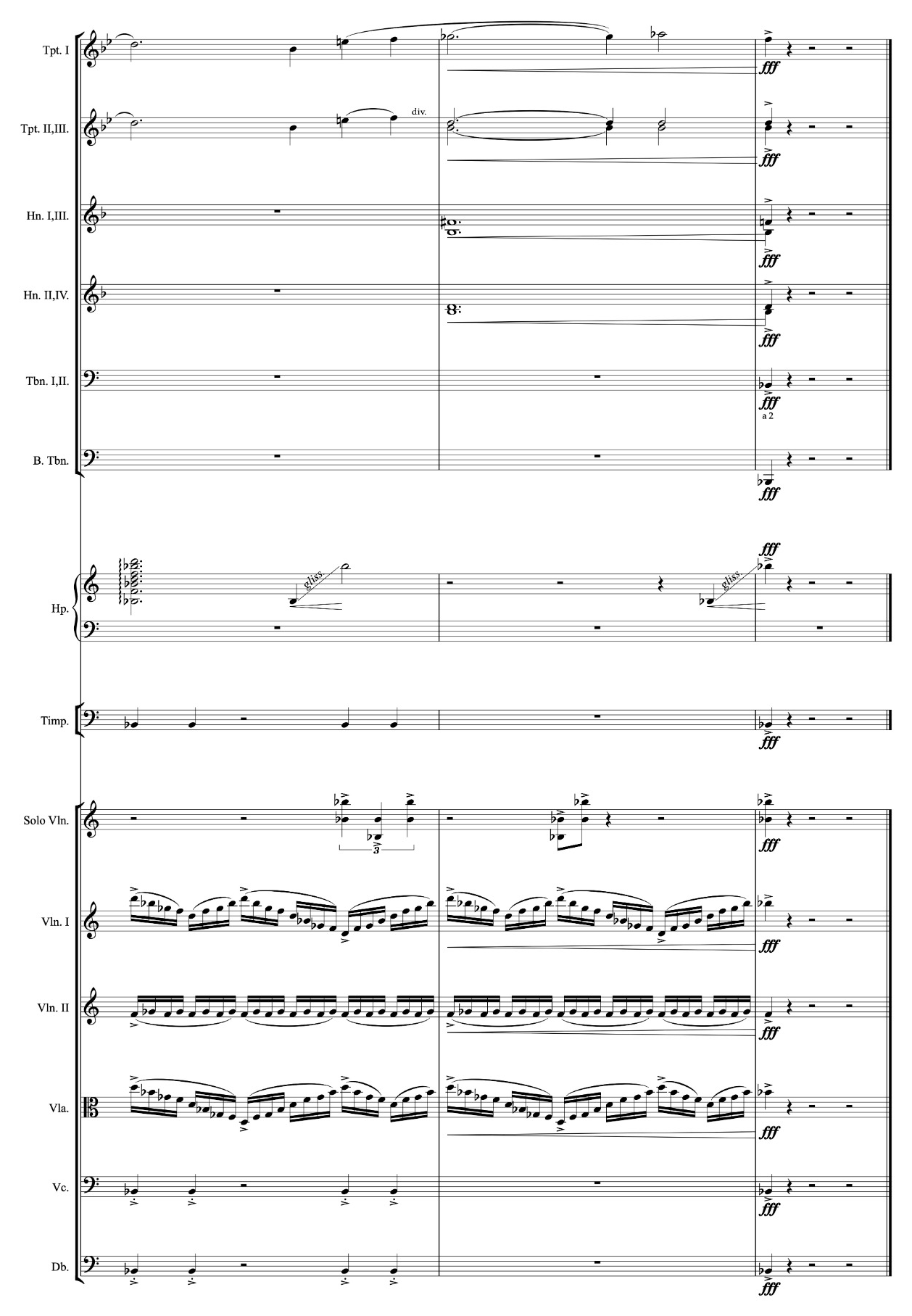
Example 9b(ii). Closing bars through 408: trumpet proclamation and full-ensemble cadence.
The Concerto as a Whole
The three movements share a musical language of recognisable motives, transformed harmony and changing orchestral roles. In the first movement, the Opening Declaration, Guerriero, the irregular waltz, the Tritone Fanfare and Arîn are drawn into a large sonata argument that culminates contrapuntally at bar 310 and resolves through the return of the opening motto.
The second movement turns from outward conflict to inward expression. Theme A emerges from the ensemble into the solo violin; Theme B takes the reverse route and reaches a collective climax. The final change from D♯ to D natural gives the smallest melodic detail a decisive expressive role.
The finale gathers contrasting episodes into a recognisable sequence of returns. Familiar themes, often transposed, are encountered again after their initial variety, creating continuity through anticipation and recollection.
Mahler’s Eighth Symphony enters this process as an acknowledged musical inheritance. The coda then recalls the irregular metre of the first movement and carries the closing theme through strings, solo violin and brass, with the trumpets delivering the final statement.
The concerto’s origins are as varied as its themes: a first movement composed in 2013, a slow movement adapted from unused film music, and a finale assembled and refined through 2016–17. Completed by November 2017, the work absorbed new historical meanings without surrendering the identity of its earlier material. Its unity lies above all in the way those ideas are transformed and made to return.
The composer’s aesthetic perspective
The Violin Concerto belongs to Webb-Mitchell’s planned Philosopher Concertos series. It treats the inherited resources of tonality, melody and thematic development as a living expressive language. Musical expectation, recognition and transformation are central to its design; the Mahler quotation makes its dialogue with earlier symphonic music explicit.
Sources and Acknowledgements
This study draws on the 2013 first-movement pencil manuscript and dated piano demonstrations; the July 2016 combined Part II orchestration sketch; the finale piano sketch of 27 January 2017; the 414-bar orchestral finale of August–October 2017; the separately notated slow-movement score of November 2017; and the revised 2024 orchestral scores. The history of the Rebellious Teenagers submission, the interruption associated with Koh-i-Noor and the contents of the 28 November 2017 demonstration is supplemented by the composer’s first-hand account.
Public Records and Contemporary Testimony
IMDb. Rebellious Teenagers (青涩日记, 2015), full credits. Webb-Mitchell is credited with English translation, not the released score. https://www.imdb.com/title/tt7436328/fullcredits/
dianyingblog 电影. “Rebellious Teenagers 青涩日记”, 20 August 2019. Review of the completed film and the soundtrack used in it. https://dianyingblog.wordpress.com/2019/08/20/rebellious-teenagers-%e9%9d%92%e6%b6%a9%e6%97%a5%e8%ae%b0/
Artı Gerçek / Mezopotamya Ajansı. “Arin Mirkan anısına klasik müzik konseri”, 28 April 2018. Announcement of the Cologne premiere. https://artigercek.com/kultur-sanat/arin-mirkan-anisina-klasik-muzik-konseri-55147h
Slipped Disc. “A British lament for a Kurdish female fighter is premiered in Germany”, May 2018. https://slippedisc.com/2018/05/a-british-lament-for-a-kurdish-female-fighter-is-premiered-in-germany/
Cologne premiere interviews, 2018. Film featuring Volker Hartung, Elisabeth Basoff-Darskaja and Arsenis Selalmazidis. https://youtu.be/HnQjghuajLQ
Cologne premiere performance, 29 April 2018. Video circulated under the title Violin Concerto “Arin Mirkan”, with Basoff-Darskaja, Hartung and the Cologne New Philharmonic Orchestra. https://youtu.be/GKai1mcVDLA
YPJ International (@YPJInt), X, 30 May 2018. Shared the performance recording. https://x.com/YPJInt/status/1001911261066596352
El Ángel de Kobane (@Copa_Kobane), X, 11 March 2019. Shared the performance recording. https://x.com/Copa_Kobane/status/1105058993238667266
Mirovatî – Defend Rojava (@mirovatii1), X, 6 January 2025. Turkish-language post sharing the recording. https://x.com/mirovatii1/status/1876396519928307846
A. Halûk Ünal (@kelamvucutbulur), X, 6 August 2025. Reposted the January 2025 recording. https://x.com/kelamvucutbulur/status/1953124815138635972
 s
 English (UK)
 简体中文